Same-Sex: Same Entitlements Report
Discover findings on financial and work-related entitlements denied to same-sex couples compared to opposite-sex couples and families in Australia.
Summary
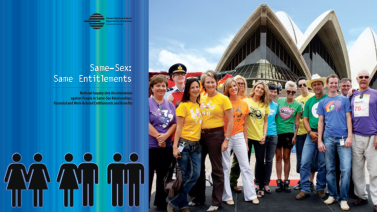
Released in 2007, the Same-Sex: Same Entitlements report summarised the findings of the National Inquiry into Discrimination Against People in Same-Sex Relationships: Financial and Work-Related Entitlements and Benefits.
It found that same-sex couples and families were denied basic financial and work-related entitlements which opposite-sex couples and their families took for granted.
A note from the Commission
This report was published in 2007. The Commission acknowledges that language in this space has evolved over time and recognises that some of the definitions and terminology used in previous work are outdated and do not reflect current understandings of LGBTIQA+ identities and experiences.
About the report
In Australia, thousands of same-sex couples experience systematic discrimination on a daily basis.
Some of the primary issues facing same-sex couples in Australia are:
- Systematic discrimination: Over 20,000 same-sex couples in Australia face daily discrimination, lacking financial and work-related entitlements that opposite-sex couples enjoy.
- Financial and legal inequities: Same-sex couples incur higher medical costs, lack access to tax concessions, superannuation, and workers' compensation benefits, and face higher aged care costs.
- Impact on families: Discrimination affects not only same-sex couples but also their children, leading to financial disadvantages that breach human rights and can be addressed with changes to federal laws.
This discrimination breaches human rights. And it can be stopped. All it takes is a few changes to the definitions in some federal laws.
Download the report
- Full report - Same-Sex: Same Entitlements, 2007 (PDF)
- Summary - Same-Sex: Same Entitlements, 2007 (PDF)
Download the community report
- Community report - Same-Sex: Same Entitlements, 2007 (PDF)
- Community report - Same-Sex: Same Entitlements, 2007 (WORD)
About the Same-Sex: Same Entitlements Inquiry and Report
In 2006 the Australian Human Rights Commission launched the National Inquiry into Discrimination
against People in Same-Sex Relationships: Financial and Work-Related Entitlements and Benefits.
The aim of this inquiry was to understand the impact of exclusion on same-gender couples and their families, who were not able to access basic financial and work-related entitlements.
The inquiry included:
- auditing hundreds of laws,
- public discussion papers,
- 7 public hearings and 18 community forums around the country,
- more than 680 written submissions from the public.
People shared not just statistics, but their lives - the stories of families who were invisible in the eyes of Australian law.
We are an average suburban family. We are working hard and contributing to our community. We don’t want special treatment – just what others can expect from their legal and social community. Our rights are denied simply because of who we love. We just want equality.
A lesbian parent in Sydney made a similar plea:
I am not a second-class citizen and resent my family and I being treated as such. All I ask is to be treated equally, no more and no less than any other Australian. Just equal.
Same-Sex: Community Guide
Access the community guide to the 2007 National Inquiry into discrimination against same-sex couples in financial and work-related entitlements and benefits.
What the Same-Sex: Same Entitlements Report found
The Same-Sex: Same Entitlements report was released in 2007 and painted a stark picture of discrimination. It identified 58 federal laws that explicitly excluded same‑gender couples and their children, including laws relating to:
- employment
- workers' compensation
- tax
- social security
- veterans' entitlements
- health care costs
- family law
- superannuation
- aged care
- migration
The report also shared findings from the inquiry about the impact of homophobia, and how many people felt that discriminatory laws endorsed these negative attitudes.
The cost of discrimination was not abstract - it was financial, emotional, and present in everyday life.
A gay doctor put it like this:
I am a first-class taxpayer but a second-class citizen.
What this means for Human Rights
The Same-Sex: Same Entitlements inquiry reviewed financial and work-related entitlements in federal laws to identify those that discriminate against same-sex couples and their children.
58 federal laws (listed in Appendix 1) breach the International Covenant on Civil and Political Rights and the Convention on the Rights of the Child.
These laws did not recognise the human rights of same-gender couples and, in some cases, the rights of their children.
Discrimination against transgender and gender‑diverse people
The report also included findings about the impact of discrimination against transgender and gender diverse people. Several key areas of concern were raised during the inquiry, including:
- barriers to accessing appropriate healthcare
- a lack of inclusive aged care
- difficulties in accessing travel documentation including passports
The report also noted discrimination against people with innate variations of sex characteristics in accessing healthcare and inclusive aged care.
The report also highlighted that gender diverse people who were married could not change their legal documents to affirm their gender identity. This was because state and territory laws only allowed transgender people to change their legal documents if they were unmarried.
Recommendations
The Australian Government should amend these laws with a single, inclusive definition of a de facto relationship to recognise same‑gender couples and their families equally.
This would ensure that:
1. same-gender couples had equal access to financial and work-related entitlements
2. children with same-gender parents were equality protected in the area of financial and work-related entitlements.
Outcomes of the Report
The Same-Sex: Same Entitlements report led to sweeping reform.
Following this report and subsequent government audit, the Australian Government passed several reforms designed to equalise treatment for same-sex couples and their families.
The reforms took the form of two pieces of amending legislation:
the Same-Sex Relationships (Equal Treatment in Commonwealth Laws-General Law Reform) Act 2008, and
the Same-Sex Relationships (Equal Treatment in Commonwealth Laws-Superannuation) Act 2008.
These laws amended 85 other existing federal laws to recognise same‑gender couples as de facto couples. This extended fundamental rights and protections to same-gender couples and their children, including:
- recognition of parental status
- partner visas, immigration and citizenship
- social security and veterans' entitlements
- workplace rights, including parental, carers’, personal and compassionate leave
- Medicare and PBS safety nets
- superannuation benefits
- aged care assessments
- tax thresholds
- division of property and maintenance after relationship breakdown
Support is available if you need it
We appreciate that this subject may be discomforting or distressing. If you or someone you know is in an emergency and needs assistance now, call triple zero (000).
You can also find free support through our list of services, no matter where you live in Australia.