Promoting Rights for Indigenous Young People with Mental Health Issues
Discover research on protecting and supporting the rights and mental health of Aboriginal and Torres Strait Islander young people in Australia.
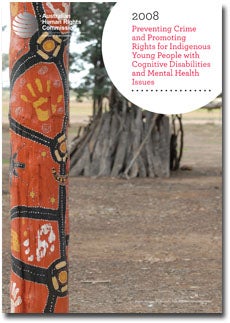
Summary
Part 1: Why do we need this research? Arguing for protection, prevention and knowledge for Indigenous young people with cognitive disabilities and mental health issuesPromoting Rights for Indigenous Young People with Mental Health Issues
- PDF download 4.2 MB
- DOC download 804.5 KB
Download
Complete report PDF [4.22 MB]
Complete report Word [805 KB]
Contents
Indigenous young people with cognitive disabilities and mental health issues and the juvenile justice system: What are the connections? Incidence of cognitive disabilities and mental health issues in the criminal justice system Incidence of young people with cognitive disabilities and mental health issues at risk of entering the juvenile justice system Limitations of the data: Identification and Indigenous concepts of disability
Limitations of the data: Identification and Indigenous concepts of disability
Indigenous young people with cognitive disabilities and mental health problems in context: Issues in development, education and the juvenile justice system Developmental and social determinants of cognitive disabilities and mental health issues in Indigenous communities Education and Cognitive Disabilities: Foundations for success or pathways to offending? Explanations for the over representation of people with cognitive disabilities in the criminal justice system Explanations for the over representation of people with mental health problems in the criminal justice system Substance use, cognitive disabilities and mental health issues
Education and Cognitive Disabilities: Foundations for success or pathways to offending?
Substance use, cognitive disabilities and mental health issues
What works: Interventions for Indigenous young people with cognitive disabilities and mental health issues Crime Prevention Crime Prevention in Indigenous Communities: Important Issues Early Intervention The risks of early intervention and Indigenous communities Early intervention for Indigenous young people with cognitive disabilities and mental health issues Diversion Impact of Diversion Diversion and Indigenous young people Diversion for Indigenous young people with cognitive disabilities and mental health problems
Diversion for Indigenous young people with cognitive disabilities and mental health problems
Incidence of cognitive disabilities and mental health issues in the criminal justice system
Limitations of the data: Identification and Indigenous concepts of disability
Education and Cognitive Disabilities: Foundations for success or pathways to offending?
Substance use, cognitive disabilities and mental health issues
Crime Prevention in Indigenous Communities: Important Issues
Early intervention for Indigenous young people with cognitive disabilities and mental health issues
Diversion for Indigenous young people with cognitive disabilities and mental health problems
Early adolescence and offending Causes of offending and early intervention Police contact Formal diversion and court contact Involvement with juvenile justice
Part 4: Conclusion and Recommendations
Appendix 1: List of consultations
Appendix 2: Government responses
Appendix 3: List of Government responses
Forward
We know that Indigenous young people in the criminal justice system are some of the most disadvantaged young people in Australia but Indigenous young people with cognitive disabilities and mental health issues face an even greater burden of disadvantage. They are faced with institutions that fail to pick up on their disabilities, services that do not cater to their needs and a culture where they are simply forgotten or put in the ‘too hard' basket.
We decided to undertake this research because so little attention is paid to this group of young people whose needs are so great.
We have approached this problem with optimism that through early intervention and diversion we can do these young people's needs justice rather than defaulting to a law and order position that results in further criminalisation of the vulnerable.
This report will look at the evidence on Indigenous young people with cognitive disabilities, map some of the services available and then based on consultations with experts, look at a variety of programs that show promise in helping these young people. This provides the basis for our best practice principles and recommendations.
I am glad to have brought some of these issues to light and look forward to sharing our findings with government departments, service providers and workers to develop a future for these forgotten young people.
Tom Calma Aboriginal and Torres Strait Islander Social Justice Commissioner and Race Discrimination Commissioner