Australia's international obligations
Explore Australia's international human rights obligations under UN conventions and treaties, and how they apply domestically to protect your rights.
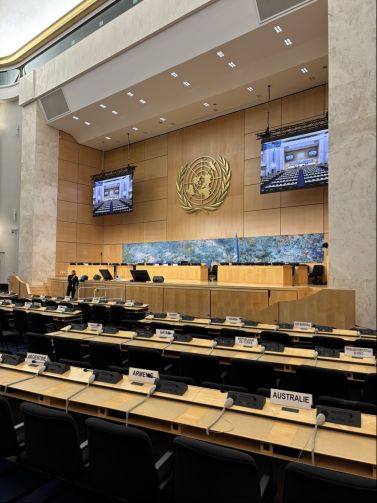
Summary
- In December 2017, Australia ratified the Optional Protocol to the Convention Against Torture (OPCAT), Australia’s progress towards OPCAT implementation has been too slow and is incomplete.
- Australia still has reservations under the International Convention on the Elimination of All Forms of Racial Discrimination (ICERD), the International Covenant on Civil and Political Rights (ICCPR), Convention on the Elimination of All Forms of Discrimination against Women and the Convention on the Rights of the Child.
Download the fact sheet
Australia's international obligations
This fact sheet provides information on issues raised in the report card as well as findings from a range of reports and submissions made by the Commission over the past 12 months.
Democratic freedoms | Recent human rights advances
It has been almost 9 years since Australia ratified the Optional Protocol to the Convention Against Torture yet some states and territories still have not established compliant systems to monitor and prevent mistreatment in places of detention.
Australia’s progress towards OPCAT implementation has been too slow and is incomplete
Safety | Urgent human rights issues
It has been almost 9 years since Australia ratified the Optional Protocol to the Convention Against Torture yet some states and territories still have not established compliant systems to monitor and prevent mistreatment in places of detention.
In December 2017, Australia ratified the Optional Protocol to the Convention Against Torture (OPCAT), marking a significant step towards establishing enhanced oversight of places of detention and improvement in conditions.
What is OPCAT
OPCAT is designed to prevent torture and other cruel, inhuman, or degrading treatment of people in places of detention through independent inspection systems known as National Preventive Mechanisms (NPM).
Australia's OPCAT progress
Australia’s progress towards OPCAT implementation has been too slow and is incomplete. Upon ratification, Australia immediately requested to delay its key obligation to establish a NPM for three years. This was granted until 20 January 2022 and a further 12-month extension was granted due to the COVID-19 pandemic, extending the deadline to 20 January 2023.
Australia missed this extended deadline to comply with its OPCAT obligations.
The Australian Government elected to adopt a multiple-body monitoring system with the Commonwealth, states and territories asked to designate their own NPM(s) within their relevant jurisdictions. Despite ratifying OPCAT nearly 8 years ago, three states still lack designated NPM bodies, other NPM bodies lack the necessary resources, and there is no national legislative framework.
Despite ratifying OPCAT nearly 8 years ago,
3 states still lack designated NPM bodies, other NPM bodies lack the necessary resources, and there is no national legislative framework.
In 2022, the Commission published a Roadmap to OPCAT compliance, outlining the immediate steps Australian governments need to take to implement OPCAT.
In October 2022, the UN Subcommittee on the Prevention of Torture (SPT) began its first official country visit to Australia. The visit was suspended after the SPT was denied access to some detention sites. The visit was officially terminated in February 2023.
Priority action
The Australian Government should ensure all Australian jurisdictions have NPMs fully operating and funded without delay.
Australia still has reservations under the International human rights treaties
Australia continues to have reservations under:
- ICERD: Art 4(a) regarding racial hatred.
- ICCPR: Art 10 (2) regarding segregation of accused and convicted persons and juveniles segregated from adults; Art 14 regarding compensation for miscarriage of justice and Art 20 regarding prohibiting propaganda of war and racial hatred.
- CEDAW: Art 11(2) regarding maternity leave.
- CRC: Art 37(c) regarding separation of children from adults in prison.
The Commission considers that changes in Australian law mean that the rationale for entering into the following reservations no longer apply: ICERD: Art 4(a); ICCPR: Art 10 (2), 14 and 20; and CEDAW: Art 11(2).
The Commission does not support the maintenance of these reservations, nor the maintenance of the reservation to Art 37(c) of the CRC.
At the time of ratification, Australia also made interpretative declarations under the CRPD. The Committee on the Rights of Persons with Disability has recommended removing the interpretative declaration.
As the Commission stated in our 2023 report to Parliament, Revitalising Australia’s commitment to human rights in 2023
when Australia entered a reservation to Article 10 of the ICCPR in 1980 it did so on the basis that compliance with the right would be ‘achieved progressively’ and stated in 1975 that the obligations in Article 4 of the ICERD would be legislated for ‘at the first suitable moment’. Both reservations remain in place 43 and 48 years after they were set into place on a short‑term basis...
It is unsatisfactory that there has been no formalised approach to reviewing reservations and interpretive declarations on a periodic basis to ensure their relevance to modern Australian life.
The Australian Government should ultimately strive to ensure that it can meet all human rights standards to the fullest extent and be open to scrutiny for how it is seeking to do so. Reservations and interpretive declarations work against this outcome and should only be maintained for the shortest time necessary and in the narrowest form possible.
The Commission has recommended that all existing reservations and interpretive declarations be reviewed as an action under a new national framework on human rights and ultimately be removed.
Ratifications
The Commission notes that Australia has not ratified the Migrant Workers Convention, although it has domestic legal and policy measures relating to human trafficking and modern slavery.
The Commission’s priority for ratification are the two individual communications optional protocols under ICESCR and the CRC. The Commission considers that communications protocols should be available to Australians. The failure to ratify these two protocols treats the rights of children and economic, social and cultural rights as less important.
Priority action
The Australian Government should ratify the Optional Protocols to ICESCR and CRC and remove reservations and interpretive declarations to human rights treaties.


