
Paid maternity leave: Supporting Parents; Valuing Children
 Sex Discrimination
Paid maternity leave: Supporting
Parents; Valuing Children
Speech delivered by Pru Goward,
Federal Sex Discrimination Commissioner at Frozen
Futures, co-hosted by the Australian Association for Infant Mental
Health and National Investment for Early Years, University of Sydney,
14 November 2002
To the organising
committee of this conference and David Lonie, Chairperson, thank you for
inviting me here today.
I am delighted to
be have been given the opportunity to address the Parliamentary Library
Vital Issues Seminar.
In a few weeks time,
I will be releasing my final report outlining options for the introduction
of a national scheme of paid maternity leave.
Since the launch
of my interim paper on this issue in April this year, there has been an
overwhelming amount of public and political debate about the need
or otherwise to introduce such a scheme in Australia.
We have to wonder,
is the volume of debate that has been generated around this issue really
warranted?
This is not
a debate about hard hitting ethical issues. We are not contemplating stem
cell technology, the finer points of human cloning or the right to life.
This is a debate
about providing women in Australia with a basic payment. A payment that
has been available to women in most other countries for decades now.
Introducing a national
scheme of paid maternity leave in Australia in the year 2002 is hardly
revolutionary thinking!
It is not going to
place Australia at the global forefront of innovative social policy measures.
To the contrary -
it will simply counteract our lag!
It can hardly be
the amount of money required to run such a scheme that has generated this
arduous debate.
Public money is continuously
spent without this level of debate - just this year, the federal Government
announced a no questions asked sugar package, comprising $120 million
dollars Commonwealth funding. [1]
The amount required
to fund a national scheme of paid maternity leave - considering the objectives
and nature of such a scheme - is hardly a figure to raise eyebrows.
The Government, the
ACTU and the National Pay Equity Coalition have all suggested that a national
scheme of paid maternity leave can be provided for under 500 million.
The most accurate
estimate will be published in my report released on December 11.
We also have to ask
why the debate around the introduction of this much needed and relatively
simple scheme has been marred by such controversy.
We continue to see
surveys highlighting the business community's scepticism about paid maternity
leave.
Just this week a
Dun and Bradstreet survey reported that executives in small and medium
sized business firms were not convinced that maternity leave would help
retain staff.
This is despite hard
evidence that Australian companies record higher retention rates since
introducing paid maternity leave.
The Australian Chamber
of Commerce and Industry continues to criticise compulsory maternity leave,
saying that businesses cannot afford to fund it.
This is despite my
continual statements that I have not and will not recommend that employers
alone pay for paid maternity leave.
A national scheme
of paid maternity leave forcing employers to make payments to employees
was included in the options paper because it is just this - an option.
As stated in the
options paper it is not however a desirable option.
From my foreword
on, that is made clear - but let me clarify.
First, nowhere in
the developed world is paid maternity leave funded through a scheme mandating
employers to directly pay employees taking maternity leave.
It is a third world
scheme.
It exists in Bahrain
and Burundi - not countries with similar economic, cultural and social
structures as Australia; not countries Australia would be looking to as
'best practice' examples.
Second, women would
suffer under an employer pays scheme.
Employers, especially
small business, keep telling us they would stop employing women of child
bearing age to avoid paying for maternity leave.
That's a view shared
by the International Labour Organization - not usually supportive of business.
Any scheme which
would result in women being further discriminated against in the workforce
is obviously unacceptable and must be avoided.
And why the drama?
Why has this nature of this debate become so tormented?
We have one politician
declaring that paid maternity leave will be introduced over his dead body.
And another, espousing
that it is nothing more than middle class welfare.
Let's take a moment
to address this assertion, which could not be further from the truth.
Under our current
system of paid maternity leave - ad hoc and employer pays - women with
high education and skill levels in full time work have greater access
to paid maternity leave.
Women in more marginal
employment - with lower skills, and who are in part time or casual work
are more likely to miss out. [2]
It is women on low
incomes who are therefore least likely to have access to paid maternity
leave, and who, along with their babies, would benefit most from the introduction
of a national scheme of paid maternity leave.
This was a sentiment
echoed in comments made by a union representative at one of the paid maternity
leave consultations held earlier this year.
Talking about production
line factory workers, the representative commented that these low income
earning women almost always return to work well before the end of the
12 month period of unpaid leave.
In fact, many are
back at full time work, six weeks after the birth of their child. The
report will deal with return to work rates comprehensively but, remember,
it is the battlers who have no access to paid maternity leave. They do
not work on production lines as a career choice. They are not racing back
to positions they love. They are there for financial reasons. They cannot
afford to be off work, unpaid. They cannot afford to lose their job.
This is perhaps why
discussion around the introduction of a national scheme of paid maternity
leave has become more than just a public debate about a social
policy measure. This debate really has become representative of a huge
journey which Australia is on.
This is because paid
maternity leave has been brought onto the national agenda at a time we
can no longer put off facing up to some of the profound social challenges
emerging in Australia.
Foremost, the challenge
of who will have our children.
Every year, slightly
fewer women of child-bearing age in Australia, as elsewhere, decide to
have children.
We are literally
becoming a society without a future generation.
Let me show you what
I mean.
Overhead 1 [3]:
The current age structure (or spread of ages in Australia). Based on the
total fertility rate in 2000, 1.75, and migration of 80,000 persons per
annum. Remember, the replacement rate, which keeps the population constant,
is 2.1 children per woman.
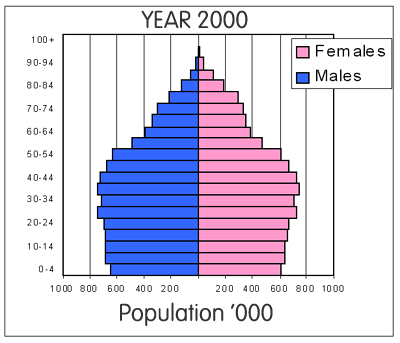
As you can see we
have a nice beehive shaped structure, with a slight bulging in the 34-44
age groups. But the ratio of dependents to supporters remains healthy.
Now let's look at
age structure projections for Australia in 2050.
Overhead 2 [3]:
A standard projection for the year 2050. Assumes that the total fertility
rate falls to 1.65 in 2005 however remains stable at this rate. This isn't
difficult. It's already fallen from 1.75 to 1.7 in a single year, 2000
to 2001, the collapse is actually speeding up, not slowing down.
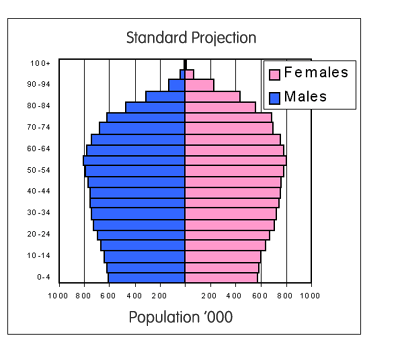
Assumes also that
the number of migrants remains constant.
What do we get?
Perhaps a few more
queen bees and a few less worker bees as we see the bulge rise slightly,
to the 44-64 years age groups, however our beehive structure still exists.
Overhead 3:
[3] This projection assumes our fertility rate
continues to decline.
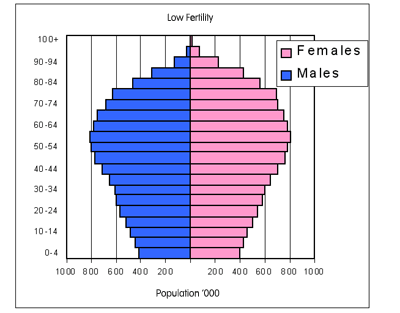
It falls to 1.65
in 2005 and then to 1.3 in 2015 where it remains constant. 1.3 is not
hard to reach. Germany, Japan and Italy got there without any trouble,
Portugal got to 1.1 before they did anything about it.
Again, immigration
remains constant.
The result?
A grim projection.
The bulge moves to
cover the 50-70 year old age groups.
Our beehive age-structure
is now replaced by a coffin. There are more dependents than there are
worker-bees.
We are certainly
well on our way.
Every year women
get older when they have their first child, every year maternity becomes
medically more difficult.
More women are having
no children, or fewer.
34 per cent of families
with children are now one child families- twenty years ago the figure
was 21 per cent.
Today, both women
and men expect to have small families - if they expect to have a family
at all!
A recently conducted
survey found that 27 per cent of men and 21 per cent of women aged 18-24
expect never to have children. [4]
Why is the Sex Discrimination
Commissioner interested in fertility? Because it is a symptom of a deeper
malaise. It's what happens when you don't women in all the combination
of choices they make, but only some.
It's what happens
when you tell a young woman you'll make sure she gets job as a mining
engineer or a police sergeant, and we'll pay her extra dollars to stay
at home with children for 5 years, but we won't help her do both, except
by subsidising her child care.
Of course a variety
of economic, biological and social changes are contributing to this fertility
trend.
First - education
and training periods are longer, meaning earning capacity begins later
in life for most young men and women. You can't begin a family if you
can't support yourself first.
Next, having spent
those years and that money on getting an education or other qualifications,
young women are understandably reluctant to trade this all in for ten
years at home, knowing how hard it will be to pick up a job or career
again at the end of it. To say nothing of their desire for independence,
for options, for security in their retirement years.
Then, the nature
of work has changed. Few young people enter the workforce with permanent
full time jobs the Bank is going to lend money for a home on. Contract
and project work is very common, with the consequence that not only do
home mortgage lenders feel understandably uncertain about the young couple's
prospects, but so does the young couple! They too, are unwilling to commit
to family responsibilities when the job is over in a few months time!
These changes not
only have implications for fertility, but for the nature of families.
It's the changing nature of families which is forcing our present rethink
of family policy, most families today need two incomes to survive. Sure,
one parent might only need to work part time, but work they both do.
It's not about saving
up for the overseas family holiday, if indeed it ever was.
Today the majority
of women will have to work part or full time for at least part of their
parenting years.
Why? Because the
real cost of living is high. In particular, housing affordability, Australia-wide,
has declined by 29% within the space of a generation. You need two incomes
to carry the mortgage on the slum of your dreams, forget the 4 bedroom
mansion with the spa bath and optional pool room!
Into this heady pressure
pack, you can now add the fact that women still bear children and somehow
have to cope with all this while juggling a major responsibility that
hasn't changed for thousands of years and isn't likely to!
Young women find
out, very quickly, that there is considerable workplace disadvantage to
be had as a result of their motherhood.
Yes, women do want
it both ways. Why shouldn't they? Men work and have children.
Put another way,
what's the point of having cake if you can't eat it too!
And so, the modern
Australian family is a two income family.
Risk management is
emerging as a major reason why we now have two income families, even when
the children are less than a year old. The risk of divorce, first of all,
and, increasingly significant, the risk of temporary unemployment for
the primary income earner.
Currently Australia's
divorce rate is just under 50% over a thirty year period, meaning that
for 50% of families, the second income earner at some stage MUST become
the primary income earner, at least for herself if not herself and her
children.
In defacto relationships,
the break-up rate, even with children, is even higher. Yes, we can work
harder at keeping marriages together, but in the mean time, we need to
address the consequences when divorce does occur.
Despite Australia's
outstanding child support system, it remains the case that divorce means
poverty for women who have not worked in the period before separation.
Thus the high percentage of single women on supporting parents' pensions.
This is compounded
in the years that follow and results in their greater dependence on welfare
for the last part of their lives.
Risk management of
divorce is a strong argument for ensuring that women must be able to choose
to both work and have children.
Risk management of
job uncertainty is another compelling reason for the two income family.
Where once skilled workers at least could be confident of continuous employment,
downsizing, restructuring, mergers and the need to be internationally
competitive means that for many, periods of unemployment are to be expected.
Families need to spread that risk by having two in work, not just one.
Low wage families have always needed to do this- now the middle class
is in the same boat.
So we have no choice
but to change - to augment our support for families, because families
have no choice.
It's not about selfishness
or personal greed on the part of young men and women.
Our task as a community
is to make the choice to have a family, their way, viable for them.
Paid maternity leave
alone will not make it possible for women to do both.
It will however respond
to some of the financial concerns discouraging women from having babies.
Why?
Because paid maternity
leave means that there will not be a total loss of income by one, or sometimes
the only income earner in a family at the time of the birth of a child.
Because every western
country in the world that's trying to facilitate the choice of women to
have children has done this by providing a package of work and family
measures. In other words they have recognised it is about enabling women
to do both. There is no package that does not include Paid maternity leave.
Paid maternity leave is a must-have.
Providing 14 weeks
of income replacement may, for a start, mean that a couple is able to
have that second child or bring forward their decision to have a child
by even one year.
What's one year you
may ask?
Considering that
physiologically fertility begins declining at 27 and the average age of
mothers in Australia is 29.8 - this one year maybe the difference
between having one child, a second child - or none at all.
Let's briefly consider
some of the other possible objectives of a national scheme of paid maternity
leave:
First, the health
and welfare objectives.
Paid maternity leave
will allow women the time needed directly after the birth of a child to
recover physically from childbirth and establish a feeding routine without
being forced to return to work due to financial necessity.
Many we consulted
related accounts of returning to work as early as two weeks after the
birth of a child, driven by the need to earn.
Yes, its true that
some women breeze through these 14 weeks without a hair out of place,
but most of us more ordinary women do find it takes a physical toll. And
babies, you'd have to admit, are just not interested in quality time -
they want all our time!
Second labour
force participation and economic growth.
Employers need to
hire best people for the job - and they need to keep them there.
This is only going
to increase as the market requires increasing numbers of skilled people,
and there are fewer from whom to choose.
At the moment, without
paid maternity leave being provided across the board, women often find
themselves in a different line of work following the birth of a child.
They may go from leading their field in IT to a part time job in a less
skilled area - but one that offers more 'family friendly' hours.
The hospitality and
retail industries for example, characterised by casual hours and shift
work are dominated by students and mothers.
This labour force
shift - of our highly skilled experts into low skilled casual work - means
that Australia loses part of its most competitive workforce. Something
we cannot afford to do in the increasingly competitive global market.
There is conclusive
evidence from a number of OECD countries that providing a universal paid
maternity leave scheme enhances female labour force attachment - in most
countries, mothers are back at work by the time the child is aged three.
It is certainly the
British experience, where paid maternity leave, even government-funded,
encourages many women to return to work, at least part time.
Third workplace
disadvantage.
Women lose their
immediate income, often jeopardise career prospects and reduce their lifetime
earnings when they leave the workforce to have children.
While it cannot make
up for the loss of income over a lifetime, paid maternity leave provides
some form of income replacement.
With no universal
scheme of paid maternity leave in place, the majority of women lose their
entire income for at least the first few months following the birth of
a child.
What is more, since
its predominately public servants and well paid women who receive paid
maternity leave from employers, it's low income families who are most
likely to be missing out.
Paid maternity leave
will mean that women can afford to be out of the workforce, while recovering
from childbirth, establishing a breastfeeding routine and bonding with
a child without the stress that they cannot financially afford to be doing
this.
Paid maternity leave
is also iconic. It is social and industrial recognition that women both
work and have children. It means we are working with, not against
this reality.
It recognises the
non-work related responsibilities of half of the people in the workforce.
Recognising paid
maternity leave as an industrial entitlement does not mean that employers
have to pay but it means employees are entitled to receive it.
These are some of
the objectives that a paid maternity leave scheme may meet.
Are they important?
Well the public thinks so, that's why they're writing in droves. The level
of public debate surround the issue makes me think that most people agree
that we have a problem - and that paid maternity leave is part of the
solution.
The question remains,
how do we do it?
The interim paper
sets out a number of other options for funding paid maternity leave. I
have not included full wage replacement as one of my options, although
the Government has recently very kindly costed such an option.
Don't worry about
all of these options.
Realistically there
are a few - really there are only two - with add ons still to be determined.
The model we have
examined most closely has been estimated by the government to cost less
than $450 million a year, is paid at the rate of the minimum wage for
14 weeks and removes the need for other benefits such as the Maternity
Allowance.
The issues remaining
to be considered therefore are:
- Should the payment
be for all women or only women in work? - Should there
be an employer top up or not?
Remember there is
always a windfall for those employers who already pay maternity leave.
The introduction
of a national scheme of paid maternity leave can be used by them to extend
the schemes they already have in place - they can be made available to
more women; they can offer other family friendly work practices. These
employers need to think laterally should a government funded national
scheme of paid maternity leave be introduced.
The questions that
remain to be addressed are contentious.
We all need
to think strategically in approaching them, and keep in mind that there
is always that window open for industrial action if government does not
step up to the plate.
As we discuss these
issues, let's bear in mind an important fact.
We already financially
support families.
Last financial year,
the Federal government committed over 10 billion dollars to direct family
assistance, including the maternity allowance, family tax benefits A and
B and a maternity immunisation allowance.
Add the amount spent
on child care and parenting payments and this amount increases to 16 billion.
Another half a billion
dollars will be spent on the baby bonus tax when it is fully implemented.
We can look back
much further than last budget to see that we have always supported families.
When we began forming
our families we received Commonwealth Bank subsidised home loan
rates; We got tax deductible private school fees; We had
access to non-means tested child endowment.
Never let
it be said we never got support.
Now the family has
changed, the sort of support we give them has got to change.
Paid maternity leave
acknowledges this.
It rises to the challenge
of the day - the challenge of supporting today's Australian families
in a sensible and effective way.
1.
The total amount given was $150 million - $30 million from the Queensland
Government and $120 million from the Commonwealth.
2. ABS
6361.0 Survey of Employment Arrangements and Superannuation April
- June 2000 unpublished data.
3. Source Data: Australian Centre for Population Research.
4. Household, Income and Labour Dynamics in Australia
Survey (HILDA Survey) data 2002.
Last
updated 30 January 2003.

