
Don't judg


Don't judge what I can do
by what you think I can't: Ten years of achievements using Australia's
Disability Discrimination Act

Contents
2. Mechanisms for eliminating discrimination
- Complaints
- Amicus curiae and intervention function
- Standards
- Temporary exemptions
- Action plans
- Promotion of awareness and compliance
- Public inquiries
- Other research and policy work
- Public transport
- Access to buildings
- Employment
- Education
- Goods and services
- Telecommunications
- Insurance and superannuation
- Accommodation
- Clubs
- Sport
4. Goals for the future and reflections on using the
DDA
1. Introduction
1.1 Preface
This publication marks ten years since the Disability Discrimination
Act (DDA) came into force in March 1993.
During these ten years, thousands of individuals and organisations have
used the DDA to create change, either by making complaints of discrimination,
using the law as a basis for negotiating broad social change or educating
organisations on their responsibilities.
There is no doubt there have been many achievements.
- Thousands of disability discrimination complaints have been dealt
with. - Standards for accessible public transport have been adopted and already
widely implemented. - Telecommunications access has improved for deaf people and other people
with disabilities. - Negotiations on standards for improved access to buildings and education
are in the final stages, and there are many practical instances of improved
access in these areas. - Captioning of television programs has increased, with further increases
being negotiated. - There has been widespread adoption by the banking and financial service
industry of standards for disability access to ATMs, internet banking,
EFTPOS and phone banking. - Hundreds of service providers, particularly local governments and
universities, have developed voluntary action plans for improved disability
access.
It also has to be acknowledged that there are areas where individuals
and advocates have expressed concern and frustration over the limits to
the law, and where progress has been more difficult than was hoped when
the legislation was passed.
There is clearly still a long way to go towards an equal and accessible
Australia that enables people with disabilities to participate fully in
the life of our nation. But, as with any long journey, it is useful and
encouraging to look at what progress we have made so far, before returning
our attention to the road ahead.
This publication presents an overview of the history and aims of the DDA,
along with the Commission's view of how the different mechanisms within
the DDA have worked over the past 10 years to achieve change. It is not
a formal review of the effectiveness of the DDA or the Commission's work,
but an attempt to highlight changes worthy of recognition.
There are examples of achievements so far in each of the main areas of
DDA coverage. There are also a number of personal accounts from individuals
who have used the different mechanisms within the DDA to achieve change
for themselves or on behalf of others.
Further material on the DDA and its implementation is available on our
website, www.humanrights.gov.au/disability_rights. I encourage anyone
who is interested in disability discrimination issues to visit this site.
I would like to acknowledge the work of current and former colleagues
and staff at the Human Rights and Equal Opportunity Commission towards
these results - in particular, the late Elizabeth Hastings, Disability
Discrimination Commissioner from 1992 to 1997, and Susan Halliday and
Chris Sidoti who acted as Disability Discrimination Commissioner before
me. Of course, many achievements have also involved our colleagues in
State and Territory equal opportunity bodies, other areas of government,
business and the non-government and Community Legal Centre sectors.
Most of all, however, I would like to acknowledge those individuals and
organisations in the disability community who have seen the value in using
the DDA as a tool for achieving equality and those who have contributed
to change by their actions.
Dr Sev Ozdowski OAM
Acting Disability Discrimination Commissioner
March 2003
1.2 History
As in many other countries, the 1981 International Year for people with
disabilities, and disability community activism stimulated by the international
year, focused attention in Australia on needs for increased recognition
and protection of human rights for people with disabilities.
In the early 1980s each of the States which already had anti-discrimination
legislation, covering grounds such as race and sex discrimination, added
coverage of disability discrimination.
1981 also saw the passage of the Human Rights Commission Act which first
established a national human rights commission. This Act defined the new
Commission's jurisdiction by reference to a number of international instruments
- including the Declaration on the Rights of Disabled Persons and the
Declaration on the Rights of Mentally Retarded Persons.
This Act (and the Human Rights and Equal Opportunity Commission Act which
replaced it in 1986) gave recognition in federal law to the human rights
of people with disabilities, but only in a very incomplete way. These
laws did not create any enforceable rights or duties - only an Ombudsman-type
power for the Commission to investigate. Also, they only applied to acts
or practices of the federal government, not (except in relation to employment
discrimination) to matters within State government administration or the
private sector.
Through the 1980s disability organisations called for stronger protection
of human rights for people with disabilities at the national level, a
call which was also endorsed by the Human Rights and Equal Opportunity
Commission (now known as the Australian Human Rights Commission, or the Commission).
In 1991 the Federal Government agreed to consider development of national
disability discrimination legislation. Initially this was part of a strategy
to improve opportunities and participation in the area of employment.
It was quickly recognised, however, that the legislation would need to
be broader in its focus than this - because of the range of barriers facing
people with disabilities in daily life which needed addressing, and because
it was clearly not possible to achieve equal opportunity in employment
without also addressing barriers in related areas such as education and
training, access to transport, and access to buildings.
1.3 Aims of the legislation
The Bill for Australia's Disability Discrimination Act ("the DDA")
was introduced in the Federal Parliament on 26 May 1992. The then Deputy
Prime Minister, Mr Howe, said:
"The Bill will assist all people with disabilities to exercise
their rights as Australian citizens and represents a landmark in achieving
human rights for all Australians. People with disabilities are entitled
to the same rights and the same opportunities as all other Australian
citizens. However, our society currently falls well short of realising
this ideal. People are still subjected to discrimination purely on the
basis of disability - discrimination which, I am sure all honourable
members would agree, is socially damaging, morally unacceptable and
a cost to the whole community The Disability Discrimination Bill
will be instrumental in continuing social change and will have far-reaching
and long-awaited effects for people with disabilities."
Mr Howe emphasised the complaint based nature of the proposed legislation
and expected that this "would promote gradual structural reforms
and attitudinal change". He noted that disability discrimination
legislation was already in place or proposed in all States and Territories.
However, national legislation was seen as necessary to achieve consistent
and comprehensive coverage.
The Bill was passed by both Houses of Parliament with bipartisan support
on 15 October 1992. Australia's first Disability Discrimination Commissioner,
Elizabeth Hastings, commenced work in December 1992. The major provisions
of the legislation, including those making discrimination unlawful came
into effect on 1 March 1993.
1.4 Overview of the DDA
The objects of the DDA are:
- to eliminate, as far as possible, disability discrimination in various
areas of life; - to ensure, as far as practicable, that people with disabilities have
the same rights to equality before the law as the rest of the community;
and - to promote recognition and acceptance within the community of the
principle that people with disabilities have the same fundamental rights
as the rest of the community.
Disability is broadly defined in the legislation to include physical,
intellectual, sensory, neurological and psychiatric disabilities. The
definition also includes people who may have a disease causing organism
in their body and people with an imputed disability (being treated as
if you have a disability). People like relatives, friends, and carers
are also protected if they are discriminated against because of association
with someone with a disability.
Discrimination is unlawful in employment, access to premises, education,
sport, clubs and associations, accommodation, administration of Commonwealth
laws and programs, and in provision of goods, services and facilities,
including public transport, finance and banking, insurance and superannuation.
Harassment on the basis of disability is specifically made unlawful in
employment, education and the provision of goods and services.
The legislation covers both direct and indirect discrimination.
Direct discrimination happens when people with a disability are treated
less favourably than people without the disability are treated or would
be treated. Indirect discrimination happens where a "one size fits
all" rule or situation unreasonably excludes or disadvantages people
with disabilities in practice.So, for example, a building with entrance
only by steps indirectly discriminates against people who use wheelchairs
or have other mobility impairments if level access or lifts or ramps could
reasonably have been provided.
2. Mechanisms for eliminating
discrimination
When the DDA was being developed it was recognized that simply passing
a law to prohibit discrimination would not be sufficient to ensure that
discrimination was eliminated or reduced. The effectiveness of any anti-discrimination
law depends on the ability of people and organizations to use it. So the
legislation provided for a range of implementation mechanisms:
- investigation and attempted conciliation of complaints of unlawful
discrimination, and reference of complaints to the courts where resolution
by conciliation cannot be achieved; - provision for the Commission to
deal with a matter on its own initiative as if a complaint had been
made; - a role for the Commission to intervene as a party in court proceedings
raising disability discrimination issues (and, more recently, for the
Disability Discrimination Commissioner to seek leave to appear as an
amicus curiae, or friend of the court, without taking sides as a party
in a case); - development of standards on what is required for non-discriminatory
access, and to set timetables for achieving it, including in employment,
accommodation, education, public transport services and access to premises; - granting by the Commission of temporary
exemptions from the legislation, to manage the transition from inaccessible
to accessible systems and facilities; - voluntary development of action plans by service providers to achieve
the objects of the legislation; - conducting inquiries, including when requested by the Attorney-General;
- promotion of awareness of and compliance with the legislation by the
Commission, including publishing
guidelines for avoiding discrimination.
2.1 Complaints
There have been over 5500 complaints lodged under the DDA.
Not all of these complaints have been successful. The Commission has
been rigorous in applying its power to decide not to deal with complaints
which are outside its responsibilities, do not raise a substantial issue
of unlawful discrimination under the DDA or, in its view, could be better
dealt with by some other statutory authority.
Of those complaints which have been dealt with, a large majority have
been settled by conciliation (although precise figures are difficult to
give for the whole period due to changes in data collection methods).
Summaries of selected complaint outcomes are presented later in this
publication. While settlements of complaints through conciliation are
generally made without admission of liability, and therefore are not legal
precedents, these summaries do show some of the results being achieved
by the DDA in practice. (Further details of conciliated settlements, Commission
decisions and court decisions under the DDA are available on the Commission's
web site.)
Compared to other legal processes, there are very few formal requirements
for discrimination complaints. Complaints do need to be put in writing
but people who have difficulty with this can ask Commission staff to assist.
Complaints can now also be made by email.
In some circumstances the Commission can also assist complainants to
find other supports they might need, like an interpreter or advocate.
A network of disability discrimination legal services was funded by the
federal Attorney-General's Department from the outset of the legislation
and there are also specific legal services focused on mental illness,
HIV/AIDS and intellectual disability.
Surveys of people who have used the complaints mechanism indicate that
most people find the Commission's conciliation service accessible and
valuable.
Some have also found the process to be stressful and time consuming and
at times unable to deliver the sort of outcome they were looking for.
Some of these concerns can be, and are being, met by continually improving
the quality of the service.
When the Disability Discrimination Act was introduced there was provision
for the Commission to pursue discrimination issues as if a complaint had
been lodged. This power was seen as highly important by disability community
organisations, partly because of their own limited resources.
However, the "self-start" power as originally drafted had some
technical defects which meant that in practice it went unused. It was
removed when the machinery provisions of the DDA and other federal anti-discrimination
legislation were revised in 1999. In any future revision of the legislation
it would be timely to consider how an enforcement role such as this could
be reinstituted.
The effectiveness of the DDA as an advocacy tool from the perspective
of a disability organization is described in this article contributed
by Aileen McFadzean, National Advocacy Officer for Blind Citizens Australia:
Discrimination against people with disabilities, intentional and unintentional,
is the cause of much of the disadvantage that people who are blind or
vision impaired experience. Blind Citizens Australia (BCA) was aware
well before the enactment of the DDA of the need for national anti-discrimination
legislation specifically for people with disabilities. Our members participated
actively in the consultation processes which developed the legislation
and campaigned strongly for its enactment into law.BCA has embraced the DDA as a tool to achieve significant change for
people with disabilities in Australia. As a national organisation, BCA's
individual advocacy service is of course nationwide. We have advocated
for people who are blind or vision impaired in all the States and Territories,
including remote areas. With an extremely limited budget, where necessary,
we travel to support people requiring advocacy support. BCA employs
a solicitor whose primary brief is to support complainants in discrimination
matters.The enactment of the DDA means that rather than relying on State and
Territory equal opportunity legislation, which didn't always exist universally,
we have been able to focus on the DDA to drive our advocacy efforts
including our systemic advocacy to change the agenda. This has enabled
us to develop a good working relationship with the Australian Human Rights Commission (the Commission) which is well-positioned to manage
the investigation and conciliation of complaints in which the complainant
might be in one state, the respondent in another and BCA's advocate
in a different one again. It has also facilitated our strategic and
systemic advocacy relating to matters under Commonwealth control, which
forms the bulk of these advocacy efforts.BCA has had a continual flow of complaints to the Commission since 1994. One
of our first complaints was against the Australian Government Publishing
Service for failing to produce the DDA in Braille. We provided support
to the complainant in one of the first cases to be decided under the
DDA, McNeill v. The Department of Social Security an employment discrimination
case. We also strongly supported Bruce Maguire in his complaints against
the Sydney Olympic Games Organising Committee (SOCOG) in relation to
the availability in Braille of the Sydney Olympic Games ticket book
and souvenir book and the accessibility of the Olympic Games web site.
The successful outcomes in these cases have been seminal to improving
the ability of people who are blind or vision impaired to access information
in their preferred accessible format. The outcome of the web site complaint
created an impetus for people to ensure the accessibility of their web
sites.BCA has used the DDA to bring actions against government departments
and private service providers including financial institutions and utilities
relating to the provision of non-discriminatory goods and services.
We have pressed for bills, statements and correspondence and public
issue documents to be provided in accessible formats and have largely
been successful in this endeavour. We have pursued education discrimination
cases to help students who are blind and vision impaired achieve their
academic potential and we advocate vigorously for Education Standards
under the DDA to become law.We have a continual flow of employment discrimination matters for which
we push for individual outcomes and used as illustrations to support
our quest for employment services which recognise the fact that employment
discrimination is rife and is a key factor in long-term unemployment
and poor training opportunities for people with disabilities.We have advocated for people who have been denied service in restaurants
and taxis and rental accommodation because they are accompanied by dog
guides and used the DDA to make our streets and buildings more accessible.
We have strongly supported the development of DDA Standards and were
pleased to have co-ordinated the DDA Standards Project between 1996
and 2000.We want people who are blind or vision impaired to be able to vote
independently and have access to political information to better inform
their voting choices. We want people who are blind to be able to sit
on juries, exercising their civil responsibilities. We need to keep
ahead of developing and developed technologies such as web sites and
ATMs to ensure that people who are blind or vision impaired have access
to the range of communication options available to sighted people. We
want to ensure that the use of new technologies such as touch pads and
visual displays in everyday consumer items does not mean that blind
people can no longer use them. There is so much more we need and want
to achieve.Although the DDA has not transformed the life experience of all people
with disabilities, it has provided a mechanism with which to fight some
forms of injustice. We have achieved some systemic change and we have
advocated for individuals for whom life may not have changed much, but
who have at least received some redress for discriminatory treatment.
We use successful outcomes where possible as precedents to make the
next win a bit easier. Our advocacy service is bubbling furiously and
it is the DDA which is providing the heat.
Experience with one unusually difficult but ultimately successful complaint
is described in this article submitted by Mr Jeff Heath, an advocate from
South Australia:
As a child I saw a movie that depicted the training of knights. In
one scene, the young hero was warned that the sword of a knight should
remain in its scabbard, "For if it is unsheathed, it has to be
used - to kill!"Most people recognise that the DDA is a powerful weapon. The urge to
use it can be strong. However it's my observation that most discrimination
as unintentional and the result of ignorance. As a result, I'm of the
view that the legislation, like the sword, should be saved as a tool
of last resort. This policy has stood me in good stead. When I complain,
I always try to offer solutions. I'm polite, but firm. I avoid becoming
emotional. As a result, the people I'm dealing with have to stay focused
on resolving the problem, not be side tracked by aggressive behaviour.My resolve was put to the test when, in 1980, I took out a post box
at the Adelaide Post Office. I needed daily access, but found that the
ramp was dangerously steep and needed to be replaced. Over the coming
years I wrote letters, had meetings, and even generated some media interest,
but still the ramp remained treacherously steep - and virtually unusable
by anyone.While one of the problems was the lack of interest by the management,
there was a very real structural problem - the floor was supported by
a vaulted ceiling. Cutting into it, had the potential to see the first
floor end up in the basement. A host of options were proposed, considered,
and found to be impracticable.By the mid 90's, I decided that if a remedy was to be found, extra
leverage would be needed. Following my initial DDA complaint, a bevy
of Australia Post engineers set to work. By 1998 a workable proposal
was formulated, only to be rejected by the Adelaide Council and the
state Heritage office.I was not happy. In 1999 I lodged a complaint under the DDA against
the three protagonists - the city, the state Government and one of Australia's
largest corporations. For nearly 12 months we held meetings, conciliation
hearings and briefings, but nothing was resolved and we were at an impasse.The Commissioner wrote to me that there was nothing more they could
do. If I wanted to continue it would have to be via the Federal Court.
This is a hard decision and should not be taken lightly. I was not eligible
for legal aid so I had to represent myself. At one hearing, it was me
against four barristers. Between hearings, I had to respond to threatening
letters from lawyers.To my surprise it still took five court appearances and nearly another
year to find a resolution. Finally, 22 years after making my first complaint,
entering the Adelaide GPO is easy, dignified and safe for people who
use wheelchairs, parents with babies and toddlers in pushers - and postal
workers with trolleys full of mail.Using the formal complaint process is not the only way people have
used the DDA to achieve change. Many individuals refer regularly to
the DDA in their discussion with service providers at a local level.
An example of this approach was provided by Mr John McKenna from Victoria:So far I have only used the formal complaint system once. The case
went in my favour, but I don't necessarily regard it as a victory, more
so, a great lesson for all.I do, however, promote the DDA regularly in another way which would
not be recorded in any statistics. During discussions with business
owners, or whoever I might happen to cross paths with, we naturally
talk about the business benefits and also the fact that whatever the
solution to an access problem might be, it can result in a win-win situation.
At the end of the day, if discussion doesn't lead to change it is so
important for me to know with confidence that I can show people what
their responsibilities are under the DDA.I am not saying you get change by simply waving the DDA, (although
that has happened on occasion), but having it there and knowing I can
use it helps me in my approach to creating change.
Removal of tribunal role
When the DDA was first passed, the
Commission acted as a tribunal to make decisions in cases where conciliated
settlement could not be reached, with the courts becoming involved only
if these decisions were not complied with. However, this power was removed
in 2000 for constitutional reasons.
Concerns were expressed by many disability organizations that the loss
of the Commission's specialist tribunal role, and the potential for costs
to be awarded against unsuccessful complainants in court, would in effect
mean the end of the DDA as an effective tool for pursuing rights.
However, no general trend has been seen so far which suggests the courts
are taking a narrower approach to interpreting the DDA than the Commission
did as a tribunal
Although there have been a small number of cases where unsuccessful complainants
have had a costs order made against them, to this point there does not
appear to have been a negative impact on complaints going forward. Nor
has there been an increase in the rate of respondents refusing to settle
cases and forcing complainants to risk the outcome in court.
2.2 Intervention and amicus role
The Commission may intervene in (become a party to) court proceedings
that involve disability discrimination issues, where it considers it appropriate
to do so and where the court hearing the proceedings gives leave.
The Commission becomes aware of proceedings in which it may intervene
through being notified by the parties, the court itself or through maintaining
a watching brief on relevant matters that are before the courts.
All requests or recommendations for the Commission to intervene in proceedings
are put to the Commission for its consideration.
The amicus curiae function means a 'friend of the court'. It does not
involve the Commission appearing as an advocate for parties to complaints.
The role does, however, allow the Commissioner to present views on the
interpretation of the DDA and how it should apply in particular situations.
This includes putting information before the court which the Commission
has gathered through public inquiry processes or through other processes
of consultation with the disability community and other experts.
So far, opportunities to appear as amicus or intervene in court proceedings
under the DDA have been limited. In several cases where the Commissioner
had indicated an interest in joining the proceedings the matter has settled
before going to hearing.
The Commissioner is interested in working more closely with disability
community organisations in exercising this function, and during 2003 will
be seeking suggestions for criteria and priorities to be applied in deciding
in which cases to become involved.
2.3 Standards
The DDA permits "disability standards" to be made by the Attorney-General
in specified areas, presently accommodation, administration of Commonwealth
laws and programs, education, employment and public transport. When the
Act was being developed it was recognised that general anti-discrimination
provisions alone would not be sufficient to achieve equality in many areas.
Building accessible buildings or transport systems, for example, involves
decisions on many detailed design issues. People responsible for these
facilities will be more ready to invest effort and money in making changes
if the law gives them some certainty about what is needed and some security
while they implement the changes required.
In other areas such as employment and education, it is more difficult
to set detailed specifications on every issue that could arise, but standards
could still perform valuable functions by setting out in more detail the
principles or processes to be applied in achieving equal opportunity.
The process of developing disability standards involves negotiation and
consultation with groups that have an interest in the area. Concern has
been expressed about the resources of the disability community to negotiate
on an equal footing. While acknowledging those concerns the Commission
supports the adoption of disability standards as offering potential for
consistent change across Australia.
The Attorney-General has given strong support to the standards development
process, including providing resources to a disability community Standards
Project to facilitate community input. However, progress with standards
has been slower than hoped.
The first disability standard to come into force, on accessible public
transport, was approved by the Parliament slightly over ten years after
the Act itself was passed.
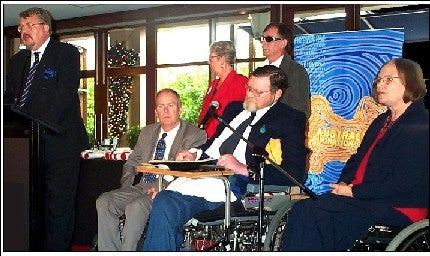
At the Human Rights Awards ceremony in December 2002, Commissioner Ozdowski
presented an award marking the DDA tenth anniversary to the community
representatives in the transport standards process (pictured above). He
said:
The accessible public transport standards stand out among other achievements
in implementing the Disability Discrimination Act because of the scale
of the changes involved, guiding billions of dollars of investment;
because of the benefits to be gained by the whole community including
people with disabilities; because of the degree of implementation the
standards have already achieved in practice around Australia; and because
of the positive precedent they have set for achieving co-operative solutions
in other areas of work under the Disability Discrimination Act.
A standard on education has been drafted, but awaits a decision by the
Ministerial Council on Employment, Education, Training and Youth Affairs.
Work has been under way for several years on a standard on access to
premises in conjunction with the Australian Building Codes Board and representatives
from interested groups. Current estimates are that completion of this
work will take at least another year.
Draft employment standards were produced in 1998 but further work has
been postponed because of a lack of consensus on whether to proceed with
regulatory standards or only with guidelines.
Some of the delay in producing standards results from the approach adopted,
and supported by the Commission, of developing standards with the widest
possible consensus, including relevant industry bodies, the disability
community and Federal and State governments.
Some delays (in particular in the adoption of the public transport standards)
have arisen from the unanticipated complexity of Regulation Impact Statement
requirements which necessitate a rigorous cost/benefit analysis of the
impact of the proposals.
There appears to be no easy way to accelerate the process of standards
development.
An issue for possible future consideration, however, is that setting
of standards is only allowed in some of the areas covered by the DDA.
Extension of the provision for making of standards to other areas would
permit additional standards to be made if this was decided to be appropriate.
2.4 Temporary exemptions
The temporary exemption power can be used as a tool to promote equality
where organisations are seeking some protection from complaints while
acting to overcome barriers to access. The Commission has not been prepared
to grant an exemption to organisations who simply want to avoid doing
anything to comply with the DDA.
The number of exemption applications to date has been quite small, except
in the public transport area, where exemptions have been a critical part
of the progress that has been achieved.
The limited take up of the exemption mechanism so far may reflect a concern
that applying for an exemption could give a negative impression, even
though the intention is not to escape responsibility for compliance, but
actually to deliver better outcomes in a planned way. It may be that a
positive power to certify compliance plans or codes as complying with
the DDA should be considered for the future.
Exemption processes are open to public participation. Some significant
exemption decisions are summarised below:
South Australian transport
In 1994 the Commission granted a twelve month exemption regarding wheelchair
access to Adelaide buses. This was to allow trials of accessible vehicles
and to develop strategies for accessible transport more generally. In
1995 a further twelve month exemption was granted on condition that an
action plan provided to the Commission was implemented.
Western Australian transport
A similar twelve month exemption was granted in 1995 to Western Australian
public transport authorities on the condition that they commence implementation
of a wide ranging action plan provided by them to the Commission.
Melbourne trams
In 1999 Melbourne's tram operators were granted a five year exemption
regarding physical access to trams, conditional on implementation of an
action plan, which meant accessible low floor trams were introduced much
sooner than previously planned. Overall fleet replacement will take 27
years, but substantial numbers of accessible trams have already started
service in Melbourne, and infrastructure changes to match them are also
occurring.
Kendell Airlines
In 2000 the Commission granted a five year exemption to Kendell Airlines
in relation to three aspects of access to small aircraft. The first of
these was wheelchair access to aircraft seats where this is prevented
by limited aisle width. The second aspect was access to aircraft or seats
for passengers requiring lifting, where this cannot be performed safely
due to space constraints. The third aspect concerned requirements for
a passenger to be accompanied by an assistant. The exemption was conditional
on reporting within 12 months on progress in a range of areas including
deployment of aisle chairs to all ports and fitting of moveable armrests
to improve access.
Olympic Roads and Transport Authority
In June 2000 the Commission granted an exemption, on application from
the Olympic Roads and Transport Authority (ORTA), to protect bus operators
and other parties concerned from liability which might otherwise arise
from the temporary transfer of accessible buses from other services to
Olympic and Paralympic related services. The Commission's view was that
accessible vehicles are likely to be introduced sooner if operators who
acquire them can choose for themselves where to use them.
Queensland Rail
An exemption for six months was granted to Queensland Rail in February
2002 regarding installation of tactile ground surface indicators. The
exemption was granted to permit discussions between relevant interested
and expert parties, to clarify safety and other issues affecting design
and installation of the indicators. These discussions were successfully
concluded in December 2002.
2.5 Action Plans
The DDA states that service providers may lodge voluntary Disability
Action Plans with the Commission. Having an Action Plan does not give
a complete defence against complaints but it can be taken into account
in dealing with a complaint.
The Commission believes that developing an Action Plan is a good way
for organisations to plan and prioritise their movement towards compliance
with the legislation.
The Commission has put considerable effort into promoting the development
of Action Plans. However, the number of organisations which have lodged
Action Plans remains small in comparison to the number of organisations
which could do so.
As at January 2003, 253 plans had been lodged with the Commission. The
plans are from 29 business enterprises, 25 non-government organisations,
31 Commonwealth government departments, 36 State and Territory government
departments, 91 local government organisations and 42 education providers.
The register of Action Plans, and those plans provided electronically
to the Commission, are available on the Commission's website. A number
of organisations have also submitted revised plans or implementation reports.
In some cases Action Plans have been developed as part of settlement
of a complaint.
There has been particularly strong take-up of Action Plans from local
government and from universities. It has been clear that staff within
these organisations have welcomed the opportunity that the development
of an Action Plan gives to make significant changes.
An article contributed by the Municipal Association of Victoria describes
the response to action plans in local government:
Victorian Local Government's response to the DDA 1992
A recent survey of councils across Victoria showed that disability
access and inclusion is now firmly on the agenda in the local government
sector. The Municipal Association of Victoria collated information from
69 councils about adopting and implementing Disability Action Plans
at a local level. A total of 86% of all councils in Victoria reported
they will have a Disability Action Plan in place by mid 2003, compared
with the 1999 figure of 31%, demonstrating significant steps forward
for this sphere of government in recent years.A typical Action Plan covers the broad range of Council activities
that go far beyond the traditional notion of "roads, rates and
rubbish." Strategies cover the areas of governance, corporate management,
information and communication, infrastructure, planning and development,
community planning & services, economic development, human resources
and environmental management.There is a healthy integration of Disability Action Plans into the
mainstream planning process of councils. Many report a link with their
Council/corporate Plans, Municipal Strategic Statements, Municipal Public
Health Plans and others. This is important because it underlines the
"whole of council" approach to access and inclusion and should
facilitate implementation and accountability.Councils also reported an increase in participation of people with
a disability. 38 councils have Disability Advisory Committees, with
a further 16 actively forming Disability Advisory Committees. 19 councils
(26% of total) report other ways of involving people with disabilities
in local policy and planning.Factors contributing to progress:
- Increasing awareness in the community of the Disability Discrimination
Act and an increasing willingness of people affected by disability
to lobby local councils.- Greater understanding that as the current generation ages it will
have higher expectations of councils with respect to accessibility
than previous generations.- General trend towards recognising and valuing diversity in local
communities- State government support for local councils in this area.
- Success of local government initiatives including the Victorian
Local Government Disability Network, the Victorian Local Government
Accessible Communities Awards and, most recently, linking members
of Disability Advisory Committees through Linking Local Action.The Victorian Department of Human Services has made a major policy
shift in working towards community inclusion as well as providing
direct disability support services. For example, its Rural Access
Program has placed full time, qualified access staff in Shires,
providing an important boost to access work in rural and regional
areas. It has also funded a Disability Access Project, based at
Municipal Association of Victoria, promoting good policy and practice
in councils.Challenges:
- Overcoming significant expenditure issues, particularly in upgrading
access to physical infrastructure, council premises and open space.
External funding for such projects is difficult to source.- Overcoming staffing issues in a world of competing claims on limited
council resources. Where a council does not employ an appropriate
staff member, tangible outcomes for people with disabilities can be
limited.- Maintaining awareness among councillors, managers and officers on
disability rights and discrimination. Where significant cultural change
is required, the "influencing" work of access workers will
take years to come to fruition.Municipal Association of Victoria plans to continue promoting full
DDA compliance with councils and to encourage strategic partnerships
with other stakeholders.
In the public transport area, several exemptions have been granted on
the condition that actions set out in an Action Plan should be implemented.
Where service providers are able to identify meaningful and measurable
targets for moving towards non discriminatory service, there appears to
be considerable further potential for this type of approach.
The first edition of the federal government's Commonwealth Disability
Strategy included a policy requirement for Commonwealth agencies and departments
to develop action plans under the DDA. While there was not complete compliance
with this policy, the number of Commonwealth agencies and departments
which do have Action Plans is relatively high.
It has also been encouraging that State and Territory departments have
been prepared to lodge action plans under Federal legislation. NSW and
Western Australian government agencies are required to produce disability
plans under their own Disability Services Acts and some of these agencies
have provided these plans to the Commission under the DDA.
In 2000 South Australia also adopted a whole of government disability
strategy which provides for preparation of action plans under the DDA
by government agencies.
While the number of plans from major businesses remains small, the Commission
has been very pleased to receive plans from major banks, telecommunications
providers and transport operators.
The Commission does not have the resources to perform any detailed evaluation
of the effectiveness or quality of Action Plans received, except where
an action plan has been part of the conditions on a temporary exemption.
The principal accountability mechanism for Action Plans have been to
make them available for public scrutiny (through the internet wherever
possible) and to encourage service providers to include public participation
in development of Action Plans and in their own reviews of implementation.
The NSW Attorney-General's Department provided the following article
for this publication on their experience with disability action plans:
Improving Access to Justice for People with Disabilities in NSW
The NSW Attorney General's Department has been implementing Disability
Strategic Plans for five years. These plans are making all of the Department's
services and programs accessible to people with disabilities.Critical to the success of this approach is the Disability Advisory
Council. Chaired by the Director General, the Council consists of 13
community members, of which at least half have disabilities. The Council
advises and assists the Department in monitoring and evaluating its
plans.The Department has provided disability awareness educational opportunities
for all Judicial Officers. A staff based team has reviewed various courtroom
procedures and incorporated their findings into the court's plans. Physical
access to all of the State's 161 courthouses has been audited and the
results integrated into the Department's 10 year Asset Maintenance Program.
New protocols for requesting interpreters and in-court infra-red assistive
hearing devices have helped clients as well as legal practitioners and
judicial officers.Staff with disabilities have also benefited through improved access,
employment policy revisions and establishment of a "staff with
disabilities" network.One of the major efforts driven by the Disability Strategic Plan has
been the commitment of $550,000 for a Flexible Service Delivery (FSD)
program. This provides training, resources, equipment (such as TTYs)
and a management framework for front-line staff to better respond to
clients with a disability. FSD does not create disability specialists
at each location, but training for all staff in accessible mainstream
service provision. FSD was delivered to 23 sites across the state in
2001/2002. In 2002/2003 eighteen more sites will participate.Staff based teams at each location have developed local service improvement
plans, informed by consultations with the local disability community.
Staff have:
- produced brochures for clients with disabilities in hard copy and
on websites, - revised the font used on formal Departmental letters;
- cleared public foyers of potential access barriers;
- improved building signage;
- improved access to court lists;
- negotiated accessible parking with local government;
- written court procedures in plain English for clients with cognitive
disabilities; - liaised with Mental Health teams;
- changed the protocols of automatic queuing systems to ensure access.
A popular manual has been developed which offers practical tips on
how to better serve people with disabilities. A number of other organisations
have shown interest in the manual and overall training program. Over
57% of staff have been trained in disability awareness.The Department is currently drafting its third disability strategic
plan for 2003-2005, which will continue to focus on practical and measurable
outcomes to minimise discrimination in the Department's services and
programs and improve access to the justice system.
2.6 Promotion of awareness and compliance
In the first year of the DDA a substantial part of the Commission's work
and budget was dedicated to a community information and education campaign.
This was aimed at people with a disability and at organisations with responsibilities
under the legislation. The campaign poster is featured on the cover of
this publication.
This campaign was carefully planned to make effective use of a limited
budget. Much more impact, however, has been seen from some high profile
complaint outcomes, such as Scott v Telstra in relation to telecommunications,
Finney v The Hills Grammar School regarding education, and Maguire v SOCOG
regarding information accessibility.
The Commission has produced advisory notes or guidelines in a number
of areas covered by the DDA: access to premises, insurance, public transport,
and world wide web access.
The development of the World Wide Web has greatly increased the Commission's
ability to publish information and advice. This has included "frequently
asked questions" material, the text of speeches, Commission and court
decisions, and links to other sources of information and advice. These
materials are also made available in print or other formats on request.
Almost 50,000 page views per month are now registered for the disability
rights section of the Commission's web site.
The Commissioner and Commission staff also promote awareness and compliance
through participation in many formal and informal educational events,
conferences, public forums, workshops and consultations.
In addition, there is significant community education and awareness activity
on rights and responsibilities undertaken by disability community groups,
State and Territory anti-discrimination bodies, industry and government
organisations and in particular through the network of Disability Discrimination
Legal Services.
2.7 Public inquiries
One of the major means for promoting awareness and compliance with the
DDA has been the conduct of public inquiries. These have been conducted
at the Commission's own initiative; in response to selected complaints
raising systemic issues; on exemption applications; and at the request
of the Attorney General.
The public inquiry process does not guarantee a successful outcome, but
it can have several benefits. It enables broad community participation
in discussion of important policy issues. It may enhance the prospects
for agreed resolution of issues (including issues which have been or could
be the subject of complaints) by gathering a wider range of information,
perspectives and options. It may also secure publicity both for discrimination
issues and for positive outcomes.
Public inquiries under the DDA have been conducted with modest resources,
using the internet as far as possible to gather and publish submissions,
and supplementing this with face to face hearings where required to gain
more information or pursue resolution of issues.
Captioning
Public inquiries in this area are described in an article contributed
by Dr John Byrne, a leading advocate for the disability community in these
processes:
Captioning of television and cinema is a significant access issue for
people who are deaf or have impaired hearing. Public inquiries by the
Commission under the Disability Discrimination
Act have been effective in improving access.
I am profoundly deaf and remember the introduction of television to
Australia in the 1950's. For deaf people, initial excitement quickly
gave way to frustration. Other frustrations included cinema, plays and
opera. Like other deaf people, I have had to rely on entertainment with
a high visual content, like sport, ballet and captioned foreign language
films.Closed captioning of television commenced in 1982, when the Australian
Caption Centre was formed. Lobbying resulted in a slow increase in captioning
of free to air television. The television industry always considered
our requests politely but outcomes were limited. In 2001 the majority
of free to air television programs on all stations were still uncaptioned
as were all pay television programs and English language films in cinemas.In her review of the first five years of the DDA in December 1997,
the inaugural Disability Discrimination Commissioner Elizabeth Hastings
commented that deaf people had been slow to make use of the DDA to increase
captioning and that greater use could increase progress with captioning
issues.In 1998 the Commission conducted a captioning inquiry that was not a result
of a complaint.The comments of Elizabeth Hastings and the Commission 1998 inquiry influenced
people in the deaf community. Complaints began to be lodged with the
Commission about lack of captioning of cinema, free to air television, pay
television and television provided in hotel rooms and places of entertainment.The Commission noted that some of these complaints raised complex issues and
had wide implications. With the agreement of the complainants and service
providers, the Commission used public inquiries as an aid to conciliation of
some of the complaints.Separate inquiries have been held for cinema, for free to air television
and for pay television. The inquiries allowed all interested people
and organisations to contribute through papers and discussion that were
then placed on the Commission web site. Meetings included industry representatives,
representatives from organisations that serve the deaf and hearing impaired
community and expertise from the Australian Caption Centre.I have attended many of the meetings of all three inquiries. All meetings
have been treated very seriously by all involved and negotiations have
occurred in good faith. The effect of the DDA has been to ensure that
negotiations use a human rights model rather than a charity model. If
an inquiry were to end without resolution, the industry and consumer
representatives realise that the matter is then likely to proceed to
the Federal Court.The cinema captioning inquiry led to introduction of captioned new
release English language films in the capital cities of all Australian
states and territories from May 2001. Australia is the world leader
in captioned cinema. For example only half of the states of the USA
show captioned movies each week. Industry and consumer representatives
have continued to meet regularly since May 2001 to plan and manage the
expansion of captioned cinema.The free to air television inquiry resulted in an offer from the industry
to significantly increase captioning and to make a joint approach to
the Federal Government to make captioning capacity mandatory on all
imported television sets. An offer is expected in the near future from
the pay television industry.Public inquiries have been valuable in improving access to captioning
and may also have value for other access issues for deaf people and
people with other disabilities. The best starting point for a public
inquiry is a complaint about discrimination to the Commission.I have been deaf since I was a child and have been lobbying for forty
years for improvements to access, including access to employment, education
and health services. I consider much more progress has occurred in the
decade since passage of the DDA than occurred in the previous thirty
years. State legislation including Disability Service Acts and Equal
Opportunity Acts have also contributed. Current legislation provides
an excellent basis for further progress over the next decade.
Medicare Benefits for Psychiatric Services
In 1996 regulations were introduced that meant the Medicare rebate for
psychiatric consultations was halved after a patient's 50th visit in any
one year. The regulations were intended to address over-servicing but
concerns were expressed about their impact on people with high support
needs. The Commission investigated whether the regulations were inconsistent
with or contrary to the objects of the Disability Discrimination Act.
The results of this examination were reported to the Attorney-General
in November 1997. The restrictions which were introduced in the 1996 Budget
on Medicare benefits in relation to certain psychiatric services were
found to have a discriminatory impact on people with a psychiatric disability.
However, as a result of modifications to the regulations following further
consultations, the Commission concluded that the regulations were no longer
inconsistent with the objects of the DDA. The restrictions which remained
were comparable to those which apply to Medicare benefits in relation
to a range of other areas of medical treatment, rather than discriminatorily
singling out psychiatric treatment and psychiatric patients. It appears
that the Commission's involvement assisted in achieving these improvements.
Public transport: Sydney Cityrail station access
In July 1999 the Commission received a representative complaint under
the DDA on behalf of people who use wheelchairs regarding access to Summer
Hill railway station. It sought implementation of accessibility at that
station in 1999-2000.
After issuing a public notice of inquiry and taking submissions, Acting
Disability Discrimination Commissioner Susan Halliday exercised the power
to decline to deal further with the complaint. (Since April 2000 this
power is vested in the Commission President). She found the complaint
was adequately remedied by an acceptable overall rate of achievement of
accessibility of stations, whether or not the particular station complained
about had priority on the list of stations to be made accessible.
Mobile phones and hearing aids
Interference from some digital mobile phones can be so severe that some
people who use hearing aids are unable to use these phones. In September
1999 the Commission announced a public inquiry into the issue, prompted
by a representative complaint under the DDA on behalf of people who use
hearing aids or cochlear implants. This inquiry was successfully concluded
in April 2001 with the announcement by Telstra, Optus and Vodafone of
schemes to provide remedies.
Electoral access
Barriers preventing people with disabilities exercising their right to
vote independently and in secret have less day to day impact than barriers
in some other areas of life. However, equal electoral access clearly has
great significance for equality of citizenship.
A number of complaints have been conciliated with agreement to improve
electoral access in particular locations. In an effort to secure broader
progress, a public inquiry into an individual complaint regarding a range
of barriers to accessibility in local government elections was conducted
in 1999. This led to agreement in 2000 by the Australian Electoral Council
- of which all Electoral Commissions are members - to establish a committee,
involving the Commission and community representation, to develop a standard
definition for access, and set benchmarks for its achievement over a period
of years. Formal progress through this committee process has not been
as effective as anticipated. However, electoral authorities have continued
to pursue improved accessibility in practice, including trials for electronic
voting.
E-commerce
In 1999-2000 at the request of the Attorney-General the Commission conducted
a public inquiry on accessibility of electronic commerce and other new
service and information technologies for people with disabilities and
older people.
The report on this reference was tabled in Federal Parliament by the
Attorney-General in June 2000.
The report welcomed advances made by internet service providers, banks
and the Federal Government in combating serious access problems faced
by older Australians and people with disabilities. The inquiry found that
some older people and people with disabilities face a number of problems
in using financial services in bill-paying and phone-based facilities
as well as barriers to accessing the world-wide web.
Following the inquiry the Commission has been assisting government and
industry bodies to develop initiatives in this area, including through
an Accessible Ecommerce Forum sponsored by the Commission and the Australian
Bankers' Association.
A major outcome has been agreement by the Australian Bankers' Association
to develop a series of industry accessibility standards, on internet banking,
phone banking, EFTPOS facilities and automatic teller machines. These
standards, developed in consultation with community representatives, were
launched in April 2002. Individual banks have now begun to release plans
for implementation of these standards.
Accessible taxis
The Commission conducted a public inquiry on aspects of wheelchair accessible
taxi services during the second half of 2001. Over 90 submissions were
received from industry, government and the disability community. Public
hearings were held in western Sydney, Melbourne, Newcastle and Perth.
A final report was released in March 2002.
The Inquiry found evidence that response times were significantly longer
for passengers requiring wheelchair accessible taxis than other passengers
making taxi bookings in some parts of Australia. It was not possible to
judge conclusively whether numbers of accessible vehicles in taxi fleets
overall need to increase to achieve equitable service, because most jurisdictions
did not have, or had only very recently established, adequate performance
monitoring for accessible taxis. Discussions with transport regulators
on improved performance monitoring are continuing.
2.8 Other research and policy work
Sterilisation
Since before the passage of the DDA the Commission has had a strong interest
in the issue of people with disabilities being unnecessarily or unlawfully
subjected to sterilising surgery. It has sought to promote appropriate
safeguards and provision of alternatives to families.
Following the publication of a commissioned report, Sterilisation of
Girls and Young Women in Australia in 1997, the Commission has held meetings
with the Department of Health and Family Services and the Attorney-General's
Department to discuss strategies to address the problem of unlawful sterilisations.
In 1998 the Commission negotiated changes to the Medicare Benefits Schedule
book. This included a note attached to the fee schedule for relevant procedures
reminding practitioners that, unless authorised by the Family Court (or
in some States an authorised Tribunal or Board), it is unlawful to sterilise
a person under eighteen unless the procedure is a by-product of surgery
appropriately carried out to treat malfunction or disease. The note also
reminds practitioners of the role of the Family Court in providing authorisation.
In 2001 a follow up report to the 1997 report on these issues was released,
and in 2002 the advocacy organisation Women With Disabilities Australia
issued their own report. Discussions with the Attorney-Generals Department
have continued on appropriate education strategies and legal reform in
this area.
Accommodation and abuse
The Commission has long been concerned with the need for more effective
measures of protection and remedy against abuse of people with disabilities
in institutional settings, and measures to ensure that people with a disability
have accommodation options consistent with Australia's human rights commitments.
The Commission conducted substantial background research in this area
in 1997. This work did not identify any options under the DDA likely to
be more effective than the continued pursuit of available mechanisms under
other laws. However, this is an issue where further attention by the Commission
may be required.
Mental health projects
The Commission conducted a small program of consultations in the mental
health sector in mid-1998 to identify areas where the Commission could
best make a contribution with modest levels of resources currently available.
The first project emerging from these consultations, a discussion paper
on 'living wills' or advance directives, was issued for public comment
in late 1998. A range of interesting and important submissions is available
with the discussion paper on the Commission's internet site. The Commission
has not had the resources for some time to follow up this work. However,
Commissioner Ozdowski hopes to conduct further research in the psychiatric
disability area commencing in 2003.
3. Areas of achievement
3.1 Public transport
Achievements in this area are described in this article contributed by
Maurice Corcoran who has had a leading role in disability community action
on public transport:
The Road to Accessible Public Transport in Australia
People with physical disabilities have been denied access to public
transport in Australia and have had as a replacement segregated, purpose-built
'taxi services'. These taxi services have been limited in numbers and
generally been under resourced, therefore have been unable to provide
an equivalent means of transport to that which the general public enjoy.There are many Australians who are not able to access our public transport
systems. The 1998 Australian Bureau of Statistics survey of Disability,
Ageing and Carers found that 1,050,700 reported difficulty using public
transport, including boarding conveyances and access to stops or stations.This situation is now changing as the result of three important pieces
of work:1. The Disability Advisory Council of Australia researched and prepared
an extensive report in 1994, (Target 2015 - A Vision for the Future)
which was both an audit of transport in Australia and a proposal for
implementing accessible transport over a 20 year timeframe;
2. Disability activists lodging successful claims of discrimination
under the DDA;
3. The development of national Disability Standards for Accessible Public
Transport which included extensive consultations and detailed analysis
via a regulatory Impact Assessment.As a direct result of complaints under the DDA, State and Federal transport
Departments have for the past 6 years begun developing integrated accessible
transport systems. In 1994 Transport Ministers recognised that accessibility
of our transport systems needed to be addressed nationally and established
a national taskforce. The taskforce included representatives of people
with disabilities; transport service providers; the Federal Attorney-General;
the Australian Human Rights Commission (previously known as Human Rights and Equal Opportunity Commission); and State and Federal
Transport Departments.A set of National Disability Standards and Guidelines were developed
under the direction of the taskforce to assist in the implementation
of accessible transport across Australia. The Standards cover all modes
of public transport including taxis, trains, trams, buses, ferries and
airlines. It also covers infrastructure such train stations, bus stations
and stops, interchanges and airports.In June 1996 these Standards were first approved by the ATC as a 'technically
feasible' way of making public transport accessible and were then subjected
to a Regulatory Impact Statement (RIS) process. The RIS investigated
the costs and benefits associated with the Standards and estimated the
implementation costs to be $3,744 million and benefits of $2,655 million,
which equates to net cost of $1,089m over a twenty year timeframe.The RIS also identified significant savings by varying the compliance
timetable for buses and extending the time for compliance for trains
and trams. The RIS and the Standards were presented back to the ATC
in June 1999 and were again approved subject to the exclusion of dedicated
school buses, charter services and ferries in open waters and on the
proviso that there be a technical review.The Standards were finally tabled in Federal Parliament on August 19,
2002 and they became law on the 23rd October 2002.Although the process has been frustratingly slow, the process has engaged
all stakeholders and has been vital for the joint ownership of the standards.
The Standards are being used across Australia by operators, manufacturers
and people with disabilities as a means to check on what and how access
provisions can be applied to public transport. The Standards are by
no means perfect, with all stakeholders having to make some compromises
along the way but they are a starting point and the best possible outcome
in the present economic and political climate.As a result of States and Territories using the Standards over the
past 6 years we already have 25% of all metropolitan buses accessible
now or approximately 1,200 in operation around Australia. A number of
States have 100% accessibility to trains already and there is considerable
work underway on infrastructure upgrades all over Australia.The Australian Human Rights Commission and in particular the Disability Rights
Unit can be justly proud of the outcomes that have been achieved so
far through the Standards and what is still to be implemented over the
next 25 years. I would also like to acknowledge all members of the National
taskforce who developed the Standards and in particular Margo Hodge,
Kevin Murfitt, the disability sector representatives and Angus Downie,
an independent appointment. Their work was recently acknowledged by
the Commission with a special award to celebrate the 10th anniversary of the
DDA.Lastly I would like to acknowledge the hundreds of organisations, individuals
with disabilities and associates who attended forums, wrote submissions
and lobbied for accessible transport. Without all of this work and commitment
the Standards would not have been achieved.
Transport complaint outcomes
Adelaide buses
Three people who use wheelchairs complained in 1994 about new inaccessible
buses being purchased. The Commission made an interim order to prevent
the purchase proceeding. The complaint was settled with the SA Government
agreeing to develop an Action Plan; obtaining 3 wheelchair accessible
buses to begin trials; and announcing that as from July 1995, the first
low floor - fully accessible buses with ramps would come into operation
at the rate of one per week. It was agreed that these buses would form
the basis of a pilot scheme for accessible public transport.
Accessibility of Perth public transport
A number of people with disabilities complained that tender documents
for public bus services in Perth failed to specify accessibility as a
requirement. Agreement was reached to establish an Action Plan under the
DDA by November 1995; for any bus contracts prior to this to specify accessibility
as a requirement; and for a temporary exemption to be applied for pending
commencement of the action plan. This Action Plan was finalised on time
after extensive consultation and launched in March 1996.
Access to NSW railway station
A student who uses a wheelchair complained that plans for a new railway
station to serve Newcastle University did not provide for access. The
Commission issued an interim order preventing tenders for construction
going ahead until the complaint was resolved. The matter was settled when
the Minister for Transport advised that this and all new railway stations
would be accessible and that he would support a national strategy for
access.
Access to Sydney buses
People with Disabilities (NSW) complained that the State Transit Authority
(STA) had ordered 150 buses without requiring that they should be accessible
to a person using a wheelchair. The complaint was settled on the basis
that while the current order would proceed, some of the 50 buses ordered
subsequently would undergo trials for accessibility as soon as possible,
in conjunction with PWD (NSW).
Ticketing access
A man who uses a wheelchair complained that ticket facilities at several
major rail stations were inaccessible to him. The complaint was settled
when the operator agreed to remove barriers at ticket booths and improve
signage of access paths.
Boarding ramps for suburban trains
A man who uses a wheelchair complained that ramps for boarding and leaving
suburban trains were not reliably provided so that on occasion he had
been unable to board or been stranded on a train far past his destination.
The complaint was settled when the rail operator adopted new operating
procedures developed in consultation with disability organisations.
Taxi access for guide dog users
Two vision impaired people complained that taxis at a major airport were
refusing to take passengers accompanied by guide dogs. The complaint was
settled when the taxi regulatory authority concerned advised that they
were drafting a general directive to all taxi operators informing them
of the relevant provisions of the local anti discrimination law and passenger
transport legislation as well as the DDA.
Oxygen on plane
A man with emphysema which requires him to use a supplementary oxygen
supply on airplanes complained that he had not been allowed to use his
privately-obtained oxygen supply which had cost him $27, but instead was
required to buy and use oxygen supplied through the airline at a cost
of $400. A conciliation agreement was reached for the airline to reimburse
$400, issue a written apology for the incident and change its policy permitting
passengers to use their own oxygen supply on its flights.
Airline terminal access
A man with a mobility impairment complained that a budget airline's terminal
building was inaccessible because the entrance was by steps with no ramp
access provided. The complaint was settled when the airline agreed to
install ramps and review other access features.
Transit procedures reviewed
A man who uses a wheelchair complained that when changing planes at a
foreign airport during an international flight, the airline had no proper
procedure for the transit of a person in a wheelchair from one section
of the airport to another. He claimed that the other passengers left the
aircraft immediately after arrival, but he and his partner were obliged
to wait while the aircraft was cleaned; he was then placed in a child
sized wheelchair without footrests; loaded into what appeared to be a
catering truck and driven across the tarmac in the dark; and given no
opportunity to use a toilet before boarding the second aircraft. The matter
was settled with an apology and an agreement to review procedures.
On plane wheelchair access
A woman who uses a wheelchair complained that although she had requested
and was assured of the availability of an aisle wheelchair on the plane
for an overseas holiday, this service was not made available. As a result
she had to be carried to the toilet on the plane, was uncomfortable and
felt humiliated, and because she feared drinking anything on the flight
to avoid the use of the toilet she became dehydrated.
At a conciliation conference, the airline apologised, and agreed to refund
the cost of the flights. It also advised that it has now provided aisle
wheelchairs on all its large planes and is in the process of providing
them for all its overseas flights.
Accessibility of existing long distance rail carriages
A man who uses a wheelchair for mobility complained of restricted wheelchair
accessibility on a rail operator's long distance services due to dimensions
of doors, corridors and toilet doors. In conciliation the complainant
accepted undertakings that while it would not be feasible to modify the
carriages, the operator provided a narrow wheelchair which did allow access
to the train and new carriages would be accessible.
In another complaint regarding long distance trains, a woman with mobility
disabilities complained that accessible toilets were provided only in
first class. In conciliation the operator agreed that economy passengers
requiring accessible facilities would be provided with access to facilities
in first class.
Commission decisions
Adams v. Arizona Bay Pty. Ltd., Charlie Habib and Bunge
Pty Ltd:
Discrimination and harassment was found in provision of taxi services
to a person with a physical disability. The Commission said $5000 compensation
should be paid.
3.2 Access to buildings
Physical access continues to be a constant barrier for people with disabilities.
But increasingly, there is recognition of the need for universal access.
Some of that recognition has come because of a general change in social
attitudes and awareness. Much of it has been the result of tireless work
by people with disabilities across the country, as experts, through local
access committees and through use of complaint processes.
There have now been hundreds of disability discrimination complaints
which have been resolved with an agreement to modify premises to make
them accessible. One of the most significant complaints is described in
this article by Mr Kevin Cocks, a leading member of the Queensland disability
community:
As a person who acquired a physical disability in 1981, I suddenly
became aware of the many barriers experienced by people with disability
in everyday life. Many of these barriers evolved from belief systems
that discriminated against people with disability. These attitudinal
barriers often resulted in people having limited opportunities to participate
in everyday community activities, events and life. In fact these barriers
affected the broader population for example parents with prams, the
elderly and those with temporary or hidden impairments such as a broken
leg or bad back etc.In Queensland people with disability had no legal avenue to pursue
discriminatory practices until 1991 when the Queensland Anti-Discrimination
Legislation (QADA) was enacted closely followed by the Commonwealth
Disability Discrimination Act in 1992.However with the introduction of anti-discrimination laws people with
disability have been able to challenge proposed or existing, legislation
policies, and practices that they believed to be discriminatory. This
was the case in the 'Cocks V's the Queensland Government', or better
known as 'the Convention Centre case'.The issue relating to the convention centre was an age-old problem
experienced by people who could not access premises by stairs. Stair
access to buildings either completely excluded people with mobility
disability from entering said premises or forced them to enter the building
via "the tradesmen entrance" that is down the alley past the
rubbish bins and in the back door. Not the most agreeable means to begin
an outing with family and friends.The Convention Centre case was one of the landmark decisions in terms
of access to premises for people with disabilities. In that it has:
- Certainly demonstrated that the State and Federal anti discrimination
legislation had teeth and that people with disability would use the
legislation judiciously.- Confirmed that the Building Code of the day (1992 edition) was a
discriminatory document.- Brought about an immediate update of the Building Code of Australia.
The 'access required via the principle entrance' clause was added
to Section D3 of the 1996 Edition of the Building Code.- Focussed industry attention on the lawful requirements for equitable
access to public premises. The Australian Building Codes Board are
auspicing discussion, research and regulatory development. This has
fed in to the development of an Access to Premises Standard under
the DDA. Prior to Cocks vs Qld many developers and building owners
were indifferent to the DDA and QADA.- Engendered an update of the DDA to allow an access to premises standard
to be developed. This was initially not one of the standards listed
for development in the DDA.- Placed all and sundry who design, certify or build public premises
on notice that they could no longer use outdated belief systems to
justify discriminatory practices.- Encouraged other groups concerned with access to transport to pursue
actions.In closing I share an experience I had attending a conference not long
after the opening of the convention centre. I was waiting for the lift
when the doors opened I was met by a family of four mom, dad, and two
kids. Dad had a broken leg and was on crutches mum was pushing a toddler
in a pram and holding his brothers' hand. This was evidence of a non-discriminatory
building, one which facilitated citizen participation and enjoyment.
A draft Access to Premises standard under the DDA is hoped to be available
shortly. Meanwhile, the complaint process continues to achieve results
as seen from the following summaries. As well as issues of physically
inaccessible design and construction, complaints have also dealt with
other types of discrimination, including access for blind and vision impaired
people, smoke free access for asthmatic people, and access for guide dog
users.
Conciliation outcomes
One small step, one giant leap
A woman who uses a wheelchair complained that access to her local shop
was prevented by a single step at the entrance. The store agreed that
the current practice of serving people with disabilities on the pavement
outside was not adequate. The complaint was settled with the store building
a ramp.
Prompt steps taken
A man with a vision impairment complained that he could not safely use
steps on a pedestrian walkway in a major city, because he could not see
the outline of the steps. The matter was settled when the responsible
authority marked the edge of each step with a contrasting line within
four weeks from being contacted by the Commission.
Getting customers through the door
Two groups of people with disabilities complained that the local shopping
centre had inadequate access. An agreement was negotiated to improve entrances,
signage, install a new lift and modify existing lift, improve car park
and lighting, improve access to stairs and install tactile indicators,
and relocate and improve toilets.
The pub with no barriers
A man with a physical disability complained that the only hotel in his
town was not accessible to him because of a lack of ramp access and accessible
toilets. The hotel agreed to provide access.
Accommodation of disability in footwear requirements
A man whose disability causes his feet to swell complained that he had
been excluded from an inn because he was wearing open sandals, although
he had explained his disability. The complaint was settled with an apology
and $1000 compensation.
Licensed club access for person with speech impediment
A woman with a speech impediment complained that because her disability
made her appear intoxicated, she had been refused service in a club even
when she produced a doctor's letter explaining the situation. The complaint
was settled when the club agreed to apologise and arranged for provision
and acceptance of a card authenticating the woman's disability.
Hats off
A woman who is being treated with chemotherapy for cancer and has lost
her hair complained that a club would not allow her to enter with her
hat on. The complaint was settled with an apology and an agreement to
review the club policy on hats.
A better view
A man who has quadriplegia complained that the wheelchair accessible
seating in a recently constructed tennis centre and aquatic centre had
poor lines of sight, as railings at eye height obscured the view. The
complaint was settled with alteration of the main balustrades to 800mm,
with thin steel cables installed above for safety.
Swimming pool access
A woman who uses a wheelchair because of Multiple Sclerosis complained
that her local swimming pool was not accessible to her. She could not
get into the water except by being tipped out of her wheelchair and could
only get out by being dragged up steps. The complaint was settled when
the local council agreed to implement interim access measures including
training pool attendants in safely assisting people with disabilities
into and out of the pool, and to undertake modifications including installation
of a hoist and upgrading of toilet and change rooms.
Accessible unisex toilets at pool
A mother complained on behalf of her son, who has a physical disability,
about the lack of an accessible unisex toilet at the local swimming pool.
Having to use the female toilets (in the presence of girls from his school
class) when accompanied by a female carer was extremely embarrassing for
him. After a conciliation conference the local council agreed to construct
a unisex accessible toilet.
It's not accessible if its blocked
A woman complained on behalf of her father who uses a wheelchair that
when the family attended a restaurant the "accessible" toilet
was in fact inaccessible because tables and chairs had been stacked against
it. The complaint was settled when the restaurant apologised, stating
that the furniture had been moved for cleaning and the failure to move
it back was a rare oversight.
or if you can't get to it
A man who uses a wheelchair complained that inaccessible features of
function rooms operated by a local council had resulted in discrimination
and humiliation when he attended a wedding there. Although he had been
advised the rooms were accessible, the lift was a goods lift which was
too narrow and did not operate easily even though staff attempted to assist.
As a result he was unable to reach the toilet (which was on a different
floor) in time, had to leave to change clothes and missed the wedding.
The complaint was settled with an agreement to install a lift complying
with standards for passenger use, as well as disability awareness training
and payment of compensation.
Reaching the beach
A man whose wife uses a wheelchair for mobility complained that changes
to the path to his neighbouring beach had removed access to the beach
for his wife, who had previously been able to reach and enter the water
with his assistance. In conciliation it was agreed that while it was not
possible to provide fully independent wheelchair access to the water in
the location concerned, at least assisted accessibility could be restored
by making the steps less steep. The path leading to the steps would also
be cleared and improved so that a wheelchair could be wheeled along it.
That's a guide dog, mate
Two friends complained that they had been required to leave a bar because
one of them was accompanied by a guide dog. The complaint was settled
with an apology, compensation of $3000 in total plus payment for expenses
and a donation to charity.
Guide dog access to hospital
A man who is blind complained that he had been discriminated against
by a public hospital refusing him access because he was accompanied by
his guide dog when he went to visit a family member. The matter was settled
when the hospital apologised, agreed to pay an amount of compensation
for the incident which had occurred, and clarified its policy that guide
dogs were permitted subject to a discretion to restrict access for the
dog in the interests of patient care in which case secure supervision
was to be provided for the dog and staff assistance provided instead for
the person.
Failure to ensure access conditions fulfilled
A woman who uses a wheelchair complained that her local council, which
had approved construction of a motel with disability access, had failed
to note on final inspection that a number of features of the "accessible"
suite did not in fact meet access conditions and that an accessible parking
space was lacking. The matter was settled when the council advised that
rectification of the access features had been arranged, and that staff
had increased their vigilance on access issues.
Footpath accessibility improved
A man who uses a wheelchair complained that the placement of a new bus
shelter and the condition of the adjoining footpath made access for him
unsafe. The complaint was settled when the local government authority
agreed to resurface the path.
Independent access to court house
A man who uses a wheelchair complained that recent upgrades to a capital
city Magistrates Court, although costing over $30 million, had failed
to provide for independent access for people with disabilities. In particular
he complained that the entrance had three steps with a platform lift at
the side which was not independently operable. The complaint was settled
on the basis that the respondent would install ramp access and bring other
access features into compliance with relevant Australian Standards, and
take action to ensure that future capital works of this nature would not
lead to similar problems.
Racecourse access improved
A man who uses a wheelchair complained that he was discriminated against
by lack of accessible parking and adequate wheelchair access between the
betting facilities and viewing area at a regional racecourse. The matter
was settled with an agreement to designate an accessible parking space
or spaces for trotting events; investigate means of providing appropriate
wheelchair access between the betting area and a suitable viewing area,
and in the interim to provide staff assistance on request.
Court provides parking
A man who has a disability making it difficult for him to walk long distances
complained that he had been discriminated against when he was summonsed
to appear at a court house which did not have any accessible parking near
to its entrance. The matter was settled when the respondent advised that
the local council had approved a proposal to provide two street parking
spaces nearby for people with disabilities.
Heritage doors no barrier
A woman with a physical disability complained that she was unable to
use a local Commonwealth Government office due to steps at the entrance
and inside the premises, and heavy front doors. The respondent advised
that ramp access was being arranged but they did not regard it as possible
to replace the existing doors because of their heritage significance.
The matter was settled when heritage approval for automatic doors was
in fact obtained when it was finally asked for.
Smoke free access
A man with asthma and other disabilities complained that he was unable
to use a Brisbane suburban shopping centre because smoking was permitted
throughout. On receiving the complaint and a copy of the Commission's
decision in Francey and Meeuwissen v. Hilton Hotels of Australia, the
shopping centre advised that the centre would be non-smoking forthwith.
In another case, a man with a condition causing his airways to react
to smoke complained that he was unable to use the bar at his local bowling
club safely. Smoke removal fans had been installed but not used and maintained.
The matter was settled when the club advised that the fans would be used
and kept operational and non-smoking area rules would be enforced.
Gymnasium access worked out
A man who uses a wheelchair complained that a commercial development
under construction in his small town included a first floor gymnasium
with access only by stairs. The matter was settled when the respondent
agreed to install a "Stair-Mate" device to enable people with
mobility impairments to gain access to the gym, and to obtain training
on disability issues.
Commission decisions
Druett and Cooper v New South Wales
Two people with physical disabilities complained they had been discriminated
against in 1994 by lack of provision of access for people who use wheelchairs
to serve as jurors in certain courts in Sydney and at Coffs Harbour. The
Commission found there had been a refusal to provide the service of assisting
an eligible person to perform jury duty when Ms Druett was directed against
her wishes to apply for exemption from duty. Damages of $5000 were awarded
accordingly.
Ian Cooper v. Coffs Harbour City Council
A council was held not liable for permitting discrimination in approving
an inaccessible development, on the basis that they had not acted unreasonably.
However, this decision was reversed by the Federal Court which pointed
out that liability for permitting an unlawful act was strict unless the
council had acted on an honest and reasonable mistaken view of the facts.
On rehearing the case the Commission found that "the Council did
little if anything to properly inform itself of the relevant matters so
that its belief could be supported on reasonable grounds" and was
liable accordingly.
Ian Cooper and Others v. Holiday Coast Cinema Centres
Pty Ltd
The complainants alleged unlawful discrimination in the building of a
new cinema in an existing complex with access being only by stairs. The
Commission found that to install platform lifts immediately would involve
unjustifiable hardship in the present financial circumstances of the respondent,
but to do so within five years would not. Accordingly the respondent should
be required to provide access by 2002.
Brown v. Birss Nominees Pty Ltd
$1000 damages was awarded for refusal of access to a caravan park for
a man with a hearing dog.
Francey and Meeuwissen v. Hilton Hotels
A requirement to be able to tolerate cigarette smoke was found unreasonable
and discriminatory. $2000 damages was ordered and a further inquiry process
conducted to identify what other measures might be feasible. However,
after this inquiry smoke removal technology was not ordered since no feasible
approach could be identified.
Court decisions
Sheehan v Tin Can Bay Country Club
Discrimination was found in requiring an assistance dog to be tethered,
given evidence of the training and disposition of the dog.
Haar v Maldon Nominees
$3000 damages was awarded for discrimination in access to a restaurant
for a guide dog user.
3.3 Employment
More complaints are received on employment issues than any other area
under the DDA, and a high proportion of these complaints have been resolved
by conciliation. Summaries of results of complaints through conciliation,
Commission determinations and court decisions are set out below.
A major part of the initial stimulus for introduction of national disability
discrimination legislation was as part of a strategy to improve employment
opportunities for people with disabilities (and incidentally to reduce
rates of dependence on the social security system. There is not much evidence
however that this strategy has yet succeeded. Rates of unemployment and
underemployment among people with disabilities remain much higher than
for people without a disability.
Employment is one of the areas where development of disability standards
is provided for. Considerable time and effort was spent from 1995 to 1998
by the Commission, other government agencies, and representatives of employers,
trade unions and people with disabilities, in attempting to develop such
standards.
It has not been possible to date to reach agreement on standards to introduce.
One problem has been in finding a balance between standards which are
too specific to be workable in all employment situations and standards
which are too general to give much more guidance than the existing open
ended discrimination provisions.
Although the draft standards in this area did not specify outcomes (such
as "when does a sign language interpreter have to be provided"
or "what restrictions are permissible on using machinery if a person
has epilepsy" or "what adaptive equipment should be provided
for a blind person"), they would have assisted by at least making
the principles clearer.
In particular the draft Standards tried to make clearer the duty to make
reasonable adjustments to accommodate a person's disability as part of
the duty not to discriminate. If the Disability Discrimination Act were
being drafted now the Commission would certainly seek to have more explicit
provision to this effect included in the legislation itself.
However, in the United States, where more prescriptive and detailed regulatory
requirements have been in place for some years under the Americans with
Disabilities Act, the evidence is similarly that overall employment outcomes
for people with disabilities have not improved significantly. So clearer
or more specific legislative provisions do not seem to be the whole answer.
Equal opportunity in work is not only a matter of attitudes and practice
in the workplace itself. It depends on equality in the pieces that work
is made up of - skills formation, accessible communications and information
systems, accessible premises, accessible transport and so on.
Positive results in future employment outcomes may be found from achievements
in these areas. But more direct strategies to achieve equal employment
opportunity are also necessary.
The Disability Discrimination Act does not contain any explicit requirement
even for larger or public sector employers to develop, implement and report
on positive strategies to achieve equal opportunity for people with disabilities.
There is also a need to look at whether employers have effective and
sufficiently easy access to information on how to deal with disability
accommodation issues.
There is still no equivalent in Australia for example to the U.S. Job
Accommodation Network advisory service, which provides practical information
and advice to employers on equipment or other modifications necessary
to accommodate a person's disability in the workplace, other than the
efforts of agencies like the Independent Living Centres and Technical
Aid to the Disabled (seriously under resourced compared to the task to
be performed).
The DDA cannot provide the whole of a strategy for achieving equal employment
opportunity. In the context of current welfare reform discussions, many
disability organisations have called for attention to the "other
side" of mutual obligation: the obligation of government and community
to do all they can to remove the barriers which presently exist to people
with disabilities taking advantage of opportunities and contributing more
fully in the economic life of Australia.

Employment conciliated outcomes
Unfairness easily seen
A woman complained that because she has only one eye she was refused
a telemarketing job. The complaint was settled with payment of $1000 compensation.
Police applicant survives cancer and discrimination
A woman complained that her application to join a police service had
been rejected because she had cancer of the cervix in the past. The complaint
was settled with payment of $14000 compensation and an agreement to review
medical criteria.
Hands free access
A woman with occupational over-use injury complained that a voice-activated
computer system had not been installed despite approval from IT staff
for this to occur. Instead she had been requested to transfer to different
duties. The complaint was settled when the software was installed and
$6000 compensation paid.
Diabetic bandleader marches on
A man with insulin dependent diabetes complained that he was to be discharged
from his role as an Army bandleader. The complaint was settled when it
was agreed that the man could continue in his duties subject to regular
review of medical fitness.
Adjustment to work methods
A woman with a lower back problem complained that she had been refused
a job involving house to house distribution and pick-up because she could
not carry heavy boxes. She claimed the employer had failed to consider
reasonable adjustment by allowing her to do the job carrying smaller amounts
of material at a time. The complaint was settled when the employer agreed
to review its selection procedure.
Mission impossible: eyesight tested without glasses
A woman complained that she had been refused a position involving inspection
duties for a Commonwealth authority because she could not pass an eye
test without her glasses. The complaint was settled when the authority
agreed to offer her a position.
Dismissal while in hospital
A chef complained that when he experienced a severe anxiety attack and
required seven days sick leave during which he was admitted to a psychiatric
hospital, he was dismissed. The complaint was settled with payment of
$55,000 compensation and provision of a reference.
Review of colour vision testing
A man complained after he was ruled ineligible for employment with a
security agency because of colour blindness. The complaint was settled
when the employer agreed to conduct more comprehensive testing with a
focus on the requirements of the particular employment.
Sacked after MS diagnosis
A woman complained that she had been discriminated against when her employment
as a manager was terminated two weeks after she advised her employer she
had been diagnosed with multiple sclerosis. After a small amount of time
off work for initial tests she had experienced only minor symptoms and
continued to be able to perform the job. The employer appeared however
to believe that because the effects of MS vary greatly from person to
person this meant that no-one with MS could be relied on to continue working.
The complaint was settled with payment of $6500.
Accommodation of deafness
A woman who is deaf complained of a lack of reasonable accommodation
in the workplace including provision of TTY phones, alternatives to audible
public address announcements, and lack of interpreters for important meetings.
She also alleged harassment by a supervisor for signing with other deaf
employees. The complaint was settled with an agreement to provide awareness
training for staff and supervisors, to provide for text communication
and to pay $5000 compensation.
In another case, a deaf person complained that a job search company had
refused to arrange a sign language interpreter for an interview as requested.
The complaint was settled when the company apologised and agreed in future
that it would provide reasonable adjustment for deaf people including
interpreting and that it would conduct staff training on accessibility.
Safety concerns resolved regarding deaf employee
A man with a hearing impairment complained that he had been discriminated
against by being refused an interview for a window cleaning job. The employer
had been concerned about the man's ability to fulfil safety requirements.
The complaint was settled with an apology, payment of $2000 compensation
and an undertaking to develop policies to ensure that the situation did
not occur again.
Drivers licence requirement for social worker reviewed
A woman with a vision impairment complained that she had been discriminated
against in not being considered for a job as a social worker because she
did not have a drivers licence. The position involved making some home
visits each week and the employer had considered that public transport
would not be efficient for the purpose and use of taxis would impose an
unjustifiable hardship given its recent investment in cars. After a conciliation
conference the matter was settled on the basis that a driver's licence
would be regarded as desirable rather than essential, since a review had
indicated that two thirds of social workers holding drivers licences could
be sufficient.
Need for additional training
A father complained on behalf of his son, who has an intellectual disability,
that he had been refused employment by a recruitment agency providing
staff to a Commonwealth Government Department because he needed an additional
hour's instruction at the commencement of work although he would be able
to work at the contracted rate thereafter. The Department agreed to review
its diversity policy and ensure that all contractors were aware of their
obligations under that policy.
Adjustment to working hours
A woman who has Post Traumatic Stress Disorder following an accident
complained that her employer had changed her hours of work which meant
she now could not get a lift to work and would need to use public transport.
This made her extremely fearful. The complaint was settled when the employer
agreed that her previous working hours could be maintained and that there
would be consultation before any changes.
Employment agency access
A man complained that an employment service had refused him service because
of his disability. He said that the manager advised him that he could
not be assisted and that he should go to a specialist disability job agency.
He said that he was also advised that "we do not make adjustments
here, you have to fit in the way it is". After a conciliation conference
the agency agreed to resume employment services to the complainant and
to pay him $1100 compensation.
Refusal to permit use of screen reader technology
A blind man complained that he had been discriminated against when he
was not employed after the prospective employer advised him that it could
not permit him to use his own screen reader technology (which translates
electronic text to audible speech) because the computer program could
contain viruses. This was in spite of assurances provided by an expert
on behalf of the complainant. The matter was settled with payment of $6000
compensation.
Dismissal of vision impaired salesman
A man who has impaired vision complained that he had been discriminated
against by being dismissed from his job as a salesperson. He claimed that
the store manager had not discussed any problems with him and had declined
offers of assistance from the Commonwealth Employment Service (who had
assisted the employee into the position) with resolving any problems resulting
from limited vision. More senior management conceded that the store manager
should have taken action to try to correct any problems arising from the
employee's sight deficiency and noted that they had improved their personnel
management to avoid similar situations arising. The complaint was settled
with an apology and $6000 compensation.
Refusal of interview when seen to have disability
A man with a mobility disability complained that he had been discriminated
against when applying for an advertised position. The employer had told
him when he applied in person that there was no position available. When
he applied by telephone later that day, however, he was offered an interview.
The matter was settled when the employer apologised and agreed to pay
financial compensation.
Man with hernia has barrier lifted
A man had a job offer as a linesman withdrawn when hernias were discovered
in a medical examination, although the physician advised that these should
not interfere with job performance. The complaint was settled with an
agreement by the employer to appoint the man to an equivalent position
when another vacancy arose.
Concerns about post operative complications addressed
A woman who had had a stomach operation complained that she had been
discriminated against when a Commonwealth Government authority rejected
her for employment because of concerns about possible complications from
the operation. The matter was settled with an agreement to consider a
fresh application in the light of a specialist report refuting these concerns.
Franchise complaint settled
A man with a speech impediment complained that he had been treated rudely
when seeking information about a franchise operation he was interested
in joining. The matter was settled with an apology from the franchisor.
(Note: The employment provisions of the DDA do not include franchisor-franchisee
arrangements, but at least some franchise arrangements will be covered
by section 27 of the DDA dealing with clubs and associations.)
Court decisions
Cosma v Qantas Airways
An employee unable to return to his pre-injury duties after a substantial
rehabilitation period was found to be unable to perform the inherent requirements
of the job, so no unlawful discrimination had occurred in terminating
his employment. Ability to perform inherent requirements was to be measured
against the pre-injury job, not against work which had been given during
the rehabilitation program: otherwise there would be a disincentive to
provide modified duties while attempting rehabilitation.
Darlington v CASCO
Reduction of hours because of injury was found discriminatory.
Commission decisions
Crombie v. Commonwealth of Australia
Discrimination was found on the basis of colour blindness. The Commission
decided that despite conflicting medical evidence the complainant could
in fact perform the inherent requirements of the job. Compensation of
$22,524 was awarded.
Ralph v Pemar Pty Ltd trading as Tuncurry Aluminium Windows
$3000 damages were awarded for less favourable treatment at work based
on the complainant being an associate of a hepatitis C positive person
(his girlfriend).
McDonald v. Hospital Superannuation Board
Discrimination was found against an employee with multiple sclerosis
on the basis of derogatory comments found to have been made. Damages of
$22,000 were awarded.
Rees v AusAID
A public servant with occupational overuse syndrome affecting her ability
to use a computer keyboard complained she had been discriminated against
in being refused promotion to a senior officer position. The Commission
found that the complainant could have performed the requirements of the
job if voice dictation equipment and software had been provided. The employer
had not established that use of this software on its network would impose
unjustifiable hardship.
Garity v Commonwealth Bank of Australia
Avision impaired employee was found to have been discriminated against
in not being given equal access to promotional and training opportunities.
$153,500 damages were awarded. This decision also emphasises the importance
of the principle of reasonable accommodation in disability discrimination
law.
Ryan v Neale Dennis and Dennis Deals Pty Ltd
A woman complained she had been discriminated against by being dismissed
from a car detailing job after disclosing to her employer that her husband
had died of AIDS. The Commission found she had been discriminated against
as an associate of a person with a disability and on the basis of imputed
disability and awarded $4000.
Woodhouse v. Wood Coffill Funerals Pty Ltd
The Commission found that a pallbearer who could not carry coffins safely
because of his disability would have been able to perform this requirement
if he were provided with a small amount of training, which would not have
imposed unjustifiable hardship. He had been discriminated against by being
dismissed and $16,730 damages were awarded. This decision also discusses
the meaning of inherent requirements.
Humphries v. Department of Education Employment Training
and Youth Affairs
The Commission found discrimination in failure to provide adequate equipment
for a public servant with a vision impairment to be able to word process
properly and to pursue promotion opportunities. The Federal Court later
held that the Commission had made an error in basing its decision on direct
discrimination rather than indirect. When the case was re-heard discrimination
was again found and $12,000 damages were awarded.
W v. P Pty Ltd
The Commission found that a job applicant had been discriminated against
when an interview was scheduled in an inaccessible building that had sixteen
steps despite the complainant informing the respondent of her inability
to access such a building. The complainant was awarded $2,130 damages
in relation to this interview.
Melvin v. Northside Community Service Incorporated
The complainant was dismissed after ten years employment with the respondent
as a child care worker. The dismissal was based on an optometrist's report
that Ms Melvin was "legally blind". This did not however address
her ability to perform job requirements. The Commission found that Ms
Melvin had been unlawfully discriminated against. Evidence indicated she
could in fact perform the inherent requirements of the job. Over $56,000
in damages was awarded.
McNeill v. Commonwealth of Australia
A public servant with a vision impairment whose probationary appointment
was terminated complained that she had been discriminated against. She
required additional equipment including a computer program that magnifies
text on screen. Though most of this equipment was requested before or
shortly after the complainant commenced work, it was not all fully operational
until ten months later. The Commission upheld the complaint and ordered
$50,900 compensation. The complainant would have been able to perform
the job if the required equipment had been provided when needed.
X v. Department of Defence
The complainant was discharged from the Australian Defence Forces (ADF)
after testing HIV positive. The Commission did not accept that an HIV
positive soldier could not perform the inherent requirements of the job.
However, the Federal Court overruled the decision on the meaning of inherent
requirements, and returned the matter for rehearing. The High Court confirmed
the Federal Court decision. All members of the High Court emphasised that
the inherent requirements of a job include ability to work safely and
are not restricted to performance of the physical tasks involved.
X v. Dr. McHugh, Auditor-General for the State of Tasmania
A man with a mental illness complained when his appointment was terminated
after difficulties relating to colleagues and clients. The employer had
been informed the man had a medical condition but not informed of its
specific nature. The President held that the complainant had been discriminated
against because of manifestations of a disability. He had not been given
a fair chance to show he could carry out the inherent requirements of
the job after he returned from sick leave.
3.4 Education
Equal opportunity in education presents issues across all types of disability.
Education is increasingly crucial to participation in social and economic
life. But what has been achieved through the DDA is probably more sharply
disputed regarding education than any other area.
Clearly there have been some good outcomes for parents and students who
have persisted with complaints. Questions remain however about how far
the DDA is achieving its purpose in education more broadly, and whether
the costs in time and stress for all concerned could be reduced by more
systemic approaches including adoption of standards.
Draft standards on education under the Disability Discrimination Act
are currently being considered. The draft standards do not set out time-lines
and specifications for making facilities and systems accessible. What
they do try to do is set out some broad policy guidelines which assist
education providers, as well as adults and children with disabilities
seeking education, to be clearer about what does and does not constitute
discrimination under the DDA.
In the Commission's view, the draft does not extend the application of
the DDA, or of the State and Territory legislation which has applied in
most places in Australia for at least as long as the DDA. It is to be
hoped these standards progress during 2003.
Education complaint outcomes
Diabetes at school
A mother complained that a school had failed to take reasonable measures
to accommodate her daughter's diabetes. The complaint was resolved with
an agreement for a diabetes educator to present information to staff at
the school, a meeting to be held with a Diabetes Nurse Educator to develop
a management plan, and that every endeavour be made to ensure that the
girl not be excluded from any program, activity or service provided by
the school due to her diabetes.
Medical treatment at school negotiated
A parent of a child with a disability requiring treatment and medication
during school hours complained that a public school would not administer
treatments unless she signed an indemnity which she refused to do. The
matter was settled when the education department advised that it had successfully
concluded an agreement with staff representatives so that indemnities
were no longer required.
Access to interpreter at school
Parents complained on behalf of their daughter who is profoundly deaf
and attends the local primary school. They alleged the education department
had failed to provide reasonable accommodation for the girl's disability
because it had not employed an Auslan interpreter. The parents claimed
their daughter's educational opportunities were being wasted as she could
not participate in the curriculum at all without an interpreter. After
a conciliation process the department created a new position for a full
time Auslan interpreter.
Access to interpreters in tertiary education
A TAFE student with a hearing impairment received interpreter assistance
for only four of his seven hours of face to face teaching, with the result
that he was forced to withdraw from the course. In settlement of his complaint,
the TAFE college provided a written apology and agreed that within six
months it would develop a policy to ensure full participation by deaf
students.
In another case, a deaf university student was provided with access to
an Auslan interpreter for all lectures and tutorials during the student's
four year course.
Complaint gets results for blind student
A blind university student complained that one of his lecturers did not
provide lecture notes and class material in an accessible format and that
the exam was multiple choice which disadvantaged him. He also complained
that the lecturer embarrassed him in class by stating that it would take
a long time to present material because he had to read everything aloud
for the complainant's benefit. The complaint was resolved with a plan
of action which included revising the format of the exam and providing
the complainant with consideration in relation to his exam results. The
complainant sat the exam successfully.
Access to course materials
A student with a vision impairment complained that course materials,
while provided in electronic format, were not able to be accessed by the
student's screen reader. This meant the student did not have access to
course materials at the beginning of the course. The complaint was settled
with the university agreeing to make a number of improvements to its services
to students with disabilities including the development of a Disability
Action Plan, the purchase and testing of improved text conversion software
and expanding the role of its Disability Liaison Officer.
A number of similar complaints led the Commission to conduct a forum
on access to tertiary education course materials in May 2002. Almost all
universities participated, together with disability representatives, publishers,
the Copyright Agency, the Attorney-General's Department and the Department
of Education, Science and Training. Recommendations were agreed on access
to copyright materials, provision by publishers of electronic formats,
and better coordination of production and provision of materials in accessible
formats. A working party involving the Commission, the Australian Vice
Chancellors Committee and other interested parties has been formed to
carry these issues forward.
Responding to bullying
A mother complained that her son who has an autistic disorder had been
discriminated against when he was suspended from school. She said her
son was constantly bullied at school and reacted by being aggressive,
and that the school had taken action only against her son and not the
bullies. After a conciliation conference an agreement was reached for
the boy to return to school with the support of an intervention plan,
additional teacher aide time and individual education program, as well
as for review of the school's suspension policy and strategies for dealing
with bullying.
Accommodation for exams
A woman complained that her son had been discriminated against on the
basis of dyslexia and Attention Deficit Disorder when her request for
a reading / writing assistant for an exam was refused. The complaint was
settled when the education authority agreed to permit an assistant for
the exam.
Education aide funding
The mother of a child with Downs Syndrome complained that her daughter
had been discriminated against by a State educational authority providing
education aide funding for only part of the school day. Her daughter has
behavioural challenges including running away which require supervision.
Following the Commission's inquiry, the education authority advised that
it had increased the level of funding for support services for the child
so that the mother would no longer need to fund part of the aide's time
herself.
Access by degrees
A university student with a physical disability complained that much
of the campus was inaccessible to him due to a lack of lifts, ramps and
handrails. The matter was settled when the university agreed to address
access issues through an action plan.
Graduation access for parent
A man who uses a wheelchair complained that he had been discriminated
against when his daughter's graduation was held in an inaccessible venue.
There was no lift and staff had suggested he be loaded into the dumb waiter/goods
lift instead. The school apologised and agreed that all future functions
would be in accessible venues.
Accommodating autism
Parents complained that a special school attended by their son had failed
to accommodate his disabilities, which include intellectual disability,
autism and epilepsy, when he was expelled after serious behavioural problems.
The complaint was resolved when the school undertook a series of initiatives
including procedures for greater consultation between teachers and parents,
development of more specific individual education plans for each child
to accommodate different levels of disability, and attendance for all
teaching staff at a two-day training course on autism.
Refusal of admission
The parents of a boy with a psychiatric condition complained that he
had been discriminated against when he was refused admission to a secondary
college after the principal formed the view that he was unsuitable for
mainstream schooling. After a conciliation conference the college apologised
and paid $5,000 compensation.
School enrolment secured
A mother complained that she had been unsuccessfully seeking for two
months to have her son, who has a number of disabilities including autism
and an intellectual disability, enrolled in a local school. Within two
days of the Commission contacting the student services team of the relevant
education authority, an enrolment in a special education class within
a local school had been secured on a trial basis. The complaint was withdrawn
when the trial was successful to the satisfaction of all parties.
Physical access to TAFE classes
A man with a disability complained regarding physical accessibility of
classes at his local TAFE college. The matter was settled when the TAFE
advised they would schedule classes for ground floor rooms or lift accessible
buildings wherever possible.
Participation in school camp
A secondary student with an intellectual disability was refused permission
to attend some days of a school camp because there was no funding for
an integration aide to assist him on those days. The complaint was resolved
on the basis that the school would permit attendance for the whole period
using the assistance of a volunteer, and would provide an integration
aide for the whole period of the next year's camp.
Commission decisions
Bishop v Sports Massage Training School
Discrimination was found in failure to accommodate dyslexia in exam procedure
by providing extra time; $3000 damages were awarded.
Finney v Hills Grammar School
An independent school was found to have discriminated in refusing enrolment
of girl with spina bifida. The defence of unjustifiable hardship was not
established. $42628 damages was awarded for discrimination in refusing
enrolment. The Federal Court upheld this decision.
W v. Flinders University of South Australia
The Commission dismissed a complaint of discrimination in education.
Problems in satisfying course requirements may have resulted from the
complainant's disability but this did not mean there had been discrimination.
Where accommodations of disability had been requested they had been granted
where this was consistent with the academic integrity of the course.
Kinsela v. Queensland University of Technology
A student who uses a wheelchair complained that he would not be able
to participate equally in the graduation ceremony because it was to be
held in an inaccessible venue. Even though arrangements could be made
to accommodate him on stage, he would not be able to participate in the
procession with his year group and be part of the experience of receiving
his degree in the same way as everybody else. The Commission ordered that
the graduation ceremony be moved to an accessible venue.
Greg Beattie (on behalf of Kiro and Lewis Beattie) v.
Maroochy Shire Council
Exclusion of non-immunised children from a child care centre was found
to be reasonably necessary in the interests of public health.
Court decisions
Purvis v State of NSW
The Federal Court reversed a Commission decision that a school had discriminated
by failing to respond appropriately to behavioural disabilities. Exclusion
because of behaviour was not direct discrimination because of disability.
The complainant was not treated less favourably than other students who
behaved the same way would have been treated. There was however possible
indirect discrimination, subject to consideration of the reasonableness
of behavioural requirements.
Travers v State of NSW
Failure to make the nearest accessible toilet available was found to
be unreasonable and discriminatory. $6250 damages were awarded.
3.5 Goods and services
Many of the complaints brought under the DDA regarding access to premises
have been about shops and shopping centres, bars, restaurants, and other
places where goods and services are obtained - that after all is often
why people want to be able to get in, not just to admire the building.
A smaller number of complaints have been made about discrimination in
the way services are provided. The experience of discrimination at an
individual level is described in this article by Mr John McKenna:
Sorry you can't come in
My disability has been with me since birth so the daily challenges
presented by an inaccessible world are naturally part of my everyday
life. Using an electric wheelchair means I face issues surrounding access
to public areas such as retail outlets, clubs, entertainment venues,
and naturally public transport.I continually experience two types of "sorry you can't come in"
scenarios. The first one revolves around structural issues, for example
the lift is broken or the door is not wide enough. The second scenario
revolves around people's attitudes, for example, a variety of negative
and upsetting statements such as, "you will offend our clients",
"we are not set up for people like you", and the most common
one, totally ignoring my presence.The structural issue scenarios are sometimes the more challenging ones
to rectify for obvious reasons. But no way can anyone make excuses for
people's attitudes. Smoke really comes out of my ears when I experience
a mix of both scenarios, for example when I'm told, "we don't know
if the lift works as we have been using it to store our cleaning equipment
for the past couple of years."
Public transport has been such a focus that it is addressed separately
in this publication. Information on telecommunications services is also
presented separately.
As discussed in relation to the Commission's public inquiry on electronic
commerce, banking services have also been a major focus of complaints
and of policy activity from the Commission and from industry.
A number of complaints have been made about accessibility of provision
of services and information through the internet. Because of the increasing
importance of this avenue and the potential it offers to provide access
for people with disabilities in particular, the Commission has issued
guidelines on world wide web page accessibility. Access in this area was
also one of the major themes of the Commission's inquiry on electronic
commerce and related areas.
Complaint outcomes
Access to banking services
A woman who is blind complained that her bank had discriminated against
her by not providing accessible banking services, specifically accessible
Automated Teller Machines (ATMs) and Internet banking services. The complaint
was resolved when the bank advised that it was participating in industry
efforts to find solutions, including industry working groups to establish
industry standards for ATM's and Internet Banking as well as Interactive
Voice Response and EFTPOS, arising from the Commission's accessible e-commerce
inquiry. It was also in the process of improving accessibility for people
with disabilities by introducing standard screen functions across the
ATM network and was developing an audio output ATM.
A similar later complaint was settled when the bank agreed to adopt an
industry standard on ATM access which had recently been negotiated with
assistance from the Commission.
In another case, a man who uses a wheelchair complained that he was unable
to use automatic teller machines at his local bank branches because of
the positioning of the keyboard. The complaint was settled when the bank
installed an accessible ATM at one of the branches and advised that this
was part of a wider program of replacing 700 ATMs with new machines designed
under Americans with Disabilities Act requirements to be accessible to
people with physical or vision impairments.
Ticket dispensing machines reviewed
A woman who uses a wheelchair complained that her bank had installed
a ticket dispensing machine which she was unable to access because she
could not reach the ticket dispenser. The complaint was resolved with
the respondent agreeing to engage the services of a design engineer to
ensure the dispenser complied with relevant Australian Standards.
Video hire membership
A young woman with an intellectual disability complained that she had
been refused membership of a video hire store. The store appeared to have
believed that because of her disability she would not be able to be responsible
in returning videos. The complaint was settled with an apology and payment
of compensation.
Access to credit facilities for man unable to sign name
A man who has cerebral palsy complained that his bank had discriminated
against him by refusing him a Bankcard because he was unable to sign his
name. The complaint was settled with agreement to alternative arrangements
including a phone banking account and an overdraft facility operated by
pin number.
HIV status and loan application
A complaint about a requirement to declare HIV status on a loan application
and consequent refusal to provide the loan was settled on terms of $5000
compensation, an apology and agreement to amend relevant policies and
forms.
Supermarket access improved
A man who uses a wheelchair complained that a Sydney city supermarket
was not accessible to him. Entry was through turnstiles which he could
not use. An alternative entrance gate was locked and unattended. When
he succeeded in entering after some delay he was unable to use the checkouts
which were too narrow. The matter was settled when the supermarket agreed
to install automatic doors in place of the turnstile entrance; widen one
of six checkout lanes to accommodate customers using wheelchairs; and
install signs indicating the accessible entrance and checkout.
Religious access
A woman with a disability complained that a priest at a place of worship
had told people in wheelchairs to sit on the floor as this was the rule
in temples in India. The complaint was settled when the religious organisation
advised that the incident had been an error by a visiting priest who was
not aware of the organisation's policy which did permit adjustments to
general practices to provide access.
Web site access
A woman who is blind complained that a real estate information site was
inaccessible because it could not be read by screen reader software. The
complaint was resolved when the organisation which maintains the site
made changes to ensure accessibility.
Higher price for accessible cruise cabin
The daughter of a woman who has had a stroke and uses a wheelchair complained
that she had been discriminated against on the basis of the mother's disability
when she booked cabins on a cruise boat. Only outside cabins, which were
higher priced, were accessible, and there were also access problems with
an associated tour. After a conciliation conference the complaint was
settled with an agreement to reimburse the cost of the tour and improve
accessibility information.
Conference registration fee for carer refunded
A woman with a disability complained that she had been discriminated
against by the organisers of a conference in that she had been required
to pay an additional registration fee for her attendant carer who was
not participating in the conference. The respondent apologised, refunded
the additional fees, and adopted a policy that registration fees would
not be charged for carers or support persons accompanying a conference
participant with a disability.
Truck driver's licence
A man complained he had been discriminated against when he was refused
a heavy vehicle licence because he did not meet the visual acuity standard
prescribed. The complaint was settled when the licensing body advised
that a review of requirements meant the man could now be tested for a
truck licence.
Deaf access to tourist experience
Two deaf people complained that they had been discriminated against when
a tourist adventure experience failed to provide them with Auslan interpreting
or a printed copy of the commentary provided by the guide on the experience.
The matter was settled when the respondent advised it had made arrangements
as follows: two sessions per month with interpreting provided; trials
of a hearing loop on the experience; a booklet for deaf participants and
a summary sheet of instructions for the experience; and free participation
for the complainants to enable them to provide feedback on these arrangements.
Enforcement of accessible parking spaces
A woman with a mobility impairment complained that use of accessible
parking at her local supermarket was not policed, so that these parking
spaces were in practice seldom available for people with disabilities.
The complaint was settled when the store advised it had commenced a trial
of enforcement by council officers in co-operation with the local council.
Access to regulatory documents
A number of people with vision impairments complained that an agency
issuing a draft regulatory document with particular relevance to vision
impaired people had refused to provide this document in Braille. The matter
was settled when the respondent agreed to provide a Braille version and
to extend the consultation period.
Physical accessibility of fast food chain
The mother of a girl who uses a wheelchair complained that most of the
local restaurants of a major fast food chain were not accessible. Because
of fixed seating the girl had to sit in the aisle, blocking access for
other patrons and requiring meals to be interrupted frequently for her
to be moved to let them pass. In some restaurants she was unable to eat
in the dining area at all. Heavy front doors made it difficult for her
to enter. In most of the restaurants the toilets were not accessible.
Some of the restaurants lacked an accessible route from parking spaces
to the restaurant.
The complaint was settled with an agreement to prepare and implement
an Action Plan which provided for an access audit of all sites, access
improvements by the company at sites operated by itself, and the company
to assist franchisees to undertake improvements at franchised sites. A
number of modifications to particular restaurants were also agreed and
implemented.
Access to choice of goods
A woman who has rheumatoid arthritis complained that she was unable to
choose from a selection of goods available on the second floor of a local
store as she is unable to use stairs. Staff were prepared to bring samples
down for her but this was time consuming and provided only partial access.
The complaint was resolved when the store rearranged displays to provide
a wider range on the accessible floor.
Access to cafe service
A man who uses a wheelchair complained that he was discriminated against
by the lack of access to the inside area of a Sydney city café,
which was up five stairs. The matter was settled when the proprietors
agreed to install a buzzer at an accessible point to enable patrons requiring
service at outside tables to attract attention.
Theatre accessibility improved
A young woman who uses a wheelchair because of multiple sclerosis complained
that, when she went to a major Sydney theatre, wheelchair accessible seating
was only available in the highest priced area and she had been seated
distant from her accompanying person. The complaint was settled when the
theatre provided five additional wheelchair spaces with removable seating
to enable patrons with a disability to sit with friends or other associates;
reconfigured the area to provide more room; appointed an access consultant
to work on further access improvements and arranged for accessible seating
to be available in all price ranges.
In another case, a man who uses a wheelchair complained that the choices
available to him for seating at an entertainment centre were very restricted,
and that he was unable to sit next to his wife. The complaint was settled
with an agreement that there would always be a seat for an associate next
to each designated wheelchair position and patrons using wheelchairs would
also be able to sit immediately behind seats for other family or friends,
depending on booking availability.
Hotels provide television captioning
A woman with a hearing impairment complained that a hotel she stayed
in did not provide text facilities on in-house television for movies,
cable television etc. The complaint was resolved when the hotel agreed
to install 3 teletext televisions into the hotel, and to install further
teletext televisions into all hotel rooms as televisions require replacement.
Availability of caption facilities would also be publicised.
A number of similar complaints led to similar agreements by other hotels
during 2001-2002, including one chain which agreed to install teletext
facilities in 10% of all rooms and to give a 15% discount to deaf people
until that target was achieved.
Hand controls for hire car
A man complained that he was unable to hire a car fitted with hand controls,
which he required because of his disability, when he visited a major rural
centre. The car hire company agreed to provide a car with hand controls
on reasonable notice.
Guide dog on tour
A man who is blind complained he had been discriminated against when
a tour operator refused to allow him to be accompanied by his guide dog
on a mini bus tour. The matter was settled when the operator apologised,
agreed to a change of policy to permit guide dogs in future and paid several
hundred dollars compensation.
Viewing of body of HIV positive man
An associate of a man who died of an AIDS related illness and had hepatitis
C complained that she had not been permitted to dress his body or have
the body viewed at the funeral. The complaint was settled when the union
concerned advised that it had changed its policy so that members would
handle, dress and allow viewing of HIV or hepatitis C positive people,
and that further discussions would be held with health authorities regarding
other procedures.
Shop apologises to man asked to leave because of burn
scars
A man with burn scars complained that he had been told by staff in a
shop that he was "scaring other customers away". The matter
was settled with an apology.
Commission decisions
Maguire v SOCOG
A man who is blind complained about the failure to produce the Olympic
ticket book in Braille. The Commission found that the ticket book was
so complex that having the print version read out either by SOCOG's telephone
help line or by friends or family was not an effective substitute. The
electronic version provided at a late stage was not formatted for accessibility.
The Commission rejected an argument of unjustifiable hardship, noting
that the cost of printing and distributing the ticket book was $7.18 million
compared to a cost of up to $17,500 on the preparation of perhaps 200
copies in Braille. The Commission ordered subsequent ticket books to be
provided in Braille.
In subsequent hearings, SOCOG's web site, which was inaccessible to blind
people using screen reader technology, was found discriminatory and $20,000
damages were ordered when SOCOG failed to rectify this prior to the Olympics.
X and Y v. The State of Western Australia
Two HIV positive prisoners alleged denial of educational opportunities,
work opportunities, sport and recreation, and on one occasion, access
to medical treatment due to a policy of segregation of HIV positive prisoners.
The Commission rejected arguments that segregation was necessary in the
interests of public health.
3.6 Telecommunications
Access to telecommunications services and equipment is obviously increasingly
critical for access to employment, education, and social participation.
The issue of equal access to telecommunications for people who are deaf
or have hearing impairment, and for people with a disability generally,
has been high on the lobbying agenda of disability organisations in Australia.
No issue received more political attention during the passage of the DDA
through Parliament. Again, however, it was a simple individual complaint
- albeit supported by a representative organisation and by one of the
disability discrimination legal centres - which had the most impact.
Mr Scott, who is deaf, complained that Telstra had discriminated against
him on the ground of his disability by not providing a telephone typewriter
(TTY) in his home on the same basis on which handsets were provided to
other domestic users of the telecommunication service. Commission President
Sir Ron Wilson found that Telstra had discriminated against Mr. Scott,
and against all other persons in his situation. He ordered that Telstra
provide Mr. Scott with a TTY, and that there be a further hearing on how
Telstra could avoid such discrimination in the future.
Once Telstra had accepted that there had been unlawful discrimination
they were very enthusiastic about finding solutions to this and many other
service delivery challenges. The solution they adopted was to provide
a voucher to all people who were eligible, that is who were profoundly
deaf or who had significant speech impediment so that they were not able
to use a telephone. The voucher would allow them to buy a TTY, which would
be replaced in five years. Shortly afterwards Telstra decided to produce
an Action Plan for equal access across the full range of their services.
Since then the corporation has revised its Action Plan regularly.
Another far reaching outcome of this matter has been that disability
access requirements have been incorporated, at least in general terms,
in the definition of features of a standard telephone service. This is
still only a part of the full picture of equal access to telecommunications
- since the standard telephone service and associated obligations do not
cover mobiles for example or other newer equipment and services - but
discussions are continuing between the Commission, industry, consumers and telecommunications
regulators on improvement of accessibility across the full range of telecommunications
services.
Some of these discussions have been assisted by complaints under the
legislation. In particular, as noted earlier in this publication, complaints
regarding access to mobile phones for people who use hearing aids were
investigated by a public process which led to each of the major service
providers adopting schemes to improve access and consumer information.
Other telecommunications complaint outcomes are summarised below.
Conciliation outcomes
Mobile phones for disability pensioners
A man who receives a disability pension complained that because of this
he had been refused service by a mobile phone provider. The company confirmed
that it did not service people who receive disability pensions (or sole
parent pensions) because it regarded them as presenting too high a risk
of non-payment. After a conciliation conference the company agreed to
provide service to the complainant.
Fee waived for easy call facility
A man who has cerebral palsy complained that he was charged an extra
fee for easy dial facilities which for him were essential to be able to
use the phone, rather than being an add on feature as for other customers.
The complaint was settled when the telecommunications company agreed to
waive the fee for this facility for people whose disability made dialling
difficult.
Accessible bills
A woman who is blind complained that her mobile phone bills were not
provided in a form accessible to her. The complaint was settled when the
telecommunications company agreed to provide bills in Braille.
Physical access to payphones
A man who has a disability requiring him to use a wheelchair complained
that he was being discriminated against in provision of services and facilities
in that new public payphones were too high for him to use. The complaint
was settled when Telstra advised that booths would be modified with a
bracket to allow installation of lowered payphones, and that an Action
Plan was being developed which would address accessibility of payphones
further.
3.7 Insurance and superannuation
The DDA permits insurers to make distinctions based on disability, but
only where this is reasonable. Obviously, this leaves much open to interpretation.
To assist in giving this provision more definite meaning, guidelines on
the application of the Disability Discrimination Act to insurance and
superannuation were developed during 1997 in cooperation with relevant
industry associations and in consultation with disability community representatives.
These guidelines were adopted by the Commission in March 1998 and are
available on the Commission's website.
In response to requests from the Mental Health Council of Australia and
the national depression initiative "beyondblue", the Commission
consulted interested parties on a proposal for it to conduct an inquiry
into reports that people who have experienced a depressive illness or
anxiety disorder are refused cover for insurance, in particular life insurance,
disability and income protection insurance, health insurance, travel insurance,
and loan protection insurance, or are offered cover only at very substantially
higher premiums.
The proposed inquiry was deferred when the major industry body, the Investment
and Financial Services Association (IFSA) advised that it was prepared
to auspice a cooperative process to work on issues in this area. The Commission
is continuing to work with IFSA and the Mental Health Council of Australia
on a range of measures to improve insurance access for people with depression.
This process may also have benefits in improving insurance access regarding
other areas of disability.
Insurance and superannuation complaint outcomes
Insurance and post natal depression
A woman who had experienced post-natal depression (PND) complained that
she had been discriminated against by being refused insurance. The insurer
responded that it assessed PND based on underwriting manuals which do
not make distinctions as to cause of depression. After a conciliation
conference the insurer agreed to provide insurance coverage at standard
rates as she was able to provide medical evidence that she had recovered
from PND. The insurer also agreed to pay compensation, and to write to
the international underwriting companies it deals with to highlight the
fact that PND has different effects and duration to other forms of depression.
Death and disability cover secured with limited exclusion
clause
A woman with a psychiatric disability complained that she had been refused
death or disablement cover because of her disability which she had disclosed
to the insurer. In conciliation the insurer advised it was prepared to
insure the complainant provided she submitted a medical report regarding
risks arising from her disability. The respondent subsequently provided
her with insurance cover with no restriction on death but with a restriction
for permanent disablement arising from her current disability. This resolved
the complaint.
In another case, a carpenter complained that he had been refused accident
/ sickness insurance because of a single psychotic episode eighteen months
earlier. The complaint was settled when the insurer offered cover with
an exclusion clause covering psychotic illness.
Better communication about insurance eligibility
A woman with bi-polar disorder complained of discrimination after her
application for mortgage protection insurance was refused. At a conciliation
conference it was agreed that she should have been provided with better
information on the reasons for declining her application and on alternative
products for which she could have been eligible. The insurer apologised
and paid $5000 compensation.
Income protection insurance and HIV risk
A gay man complained he had been discriminated against on the basis of
an imputed future disability (that is, the risk that he might become HIV
positive) when an insurance company refused to give him income protection
insurance, even with an HIV exclusion clause (which the complainant was
prepared to accept), for longer than a two year period. The matter was
settled when the insurer advised that it was prepared to remove the two
year limitation and issue the policy as requested.
In another case, a man complained that he had been refused income protection
insurance after disclosing that he was homosexual and had been in a relationship
with a HIV positive man, although he himself was HIV negative. The matter
was settled with an apology, compensation of $8500 and insurance being
issued subject to an HIV exclusion clause.
Blindness and income protection insurance
A computer programmer with a vision disability which may result in his
being totally blind in a few years complained when his applications for
income protection insurance were refused. He was seeking income protection
against illness or accident rather than against his possible blindness.
The complaint was settled when the insurer provided disability income
insurance with a blindness exclusion.
In another case, a woman complained that she had been discriminated against
when an insurer advised her that she would be ineligible for income protection
insurance because of her vision impairment. The matter was settled when
the insurer provided an apology and $2000 compensation, and undertook
to consider a fresh application.
Loan insurance for woman who had had melanoma
A woman complained that she had been discriminated against when she was
refused loan insurance after disclosing on the application form that she
had been treated for melanoma. The tumour had been removed 14 years previously
without recurrence or spread. After an additional medical report was obtained
the insurer agreed to provide cover for the remaining period of the loan
without charge.
Travel insurance for mental disorder
A man complained that he had been discriminated against when his insurer
refused to pay a claim on a family travel insurance policy after his son
had a panic attack in flight and the family had to return home. The claim
was refused on the basis that the claim arose from a mental or nervous
disorder which was excluded by a clause in the policy. The matter was
settled by payment of medical, travel and accommodation expenses.
Endowment insurance for boy with Tourette's syndrome
A parent complained that his son had been discriminated against by being
refused life insurance/endowment insurance cover on the basis that he
had Tourette's Syndrome and attention deficit disorder. The insurer agreed
to provide the cover as applied for, and to update its assessment manual
to include these conditions.
Employer complaint achieves superannuation cover for
employee
An employer with a vision impairment complained on behalf of an employee
that the employee had been discriminated against in the terms and conditions
of membership of a superannuation fund. The employee had applied for and
been refused additional cover beyond his automatic entitlements. The complaint
was settled by an agreement to provide the additional cover subject to
exclusion clauses which restricted benefits payable in respect of eye
diseases or disorders.
Restrictions reduced on superannuation
A university lecturer who has multiple sclerosis complained that she
was being discriminated against because the superannuation fund of which
she was compulsorily a member limited her benefits not only in relation
to her pre-existing condition of MS, but regarding any other illness or
disability. The matter was settled when the fund advised that restrictions
would be removed.
Commission decisions
Bryant and Nagy v Cuna Mutual Group
The brother and sister of a man who had died complained that an insurer
was discriminating on grounds of their late brother's HIV status in failing
to pay on a loan insurance policy. The Commission decided that the beneficiaries
of a deceased person's estate should be able to complain of discrimination
against them as associates of a person with a disability despite that
person's death.
3.8 Accommodation
Accommodation complaints have overlapped with those made under the access
to premises provision of the DDA, covering issues such as hotel room accessibility.
The accommodation provision also extends to premises which are not necessarily
open to the public, such as rental accommodation, as well as accommodation
specifically for people with disabilities.
This area however is one which shows most clearly the limitations of
the DDA as a discrimination law rather than one which guarantees fundamental
human rights more broadly. No strategy has yet been found to use the DDA
effectively to ensure adequate levels of provision of accommodation for
low income people with disabilities, or people with particular support
needs, or young people with disabilities to prevent them being consigned
to aged care.
The complaints summarised below therefore represent only a small slice
of needs in the accommodation area.
Conciliation outcomes
Hostel accommodation
A man complained on behalf of his mother in law that her application
for hostel accommodation was rejected because she had insulin dependent
diabetes. The respondent claimed that it was unable to accommodate her
because the staff at the hostel were not medically qualified and would
not be able to assist her to administer insulin or change her dosage if
required. In conciliation it was agreed that the woman would be placed
on the waiting list for accommodation subject to specialist assessment
of her care needs and the hostel's capacity to meet them.
Air conditioning as reasonable adjustment
A man who has paraplegia and thus has difficulty regulating his body
temperature complained that a public housing authority had refused to
install an air conditioner although other tenants had adjustments provided
to accommodate other aspects of disability. The complaint was settled
when the authority changed its policy to cover installation of air conditioners
where required by a person's disability.
Access improved in public housing unit
A woman who has limited ability to walk so that she uses a motorised
"gopher" to get around complained that she had been allocated
a public housing dwelling which was inaccessible to her because of lack
of ramp access, no place for her to house the "gopher" and uneven
and broken paths creating a risk of her falling. The matter was settled
when the housing department advised that it had constructed new paths,
installed a shed for the gopher, and installed ramp entry to the house,
as well as undertaking door improvements and other access improvements
inside the house.
Hotel disability access improved
A woman who had a temporary disability due to a broken foot complained
that she had been discriminated against by a major Brisbane hotel, when
she sought to book a room with a walk-in shower and was advised that the
only room available would require her to upgrade to a more expensive room.
The matter was settled when the hotel agreed that no additional fee would
be charged where a room upgrade was necessary to accommodate a guest's
disability; one suite's shower would be fitted with hand rails, temperature
regulator and shower seat; two accessible rooms would be included in the
next floor refurbishment; and added emphasis would be given to disability
awareness in staff training.
Additional fee for disability access removed
A man who uses a wheelchair complained that he had been discriminated
against by being charged an additional fee for use of the accessible accommodation
at some holiday cottages. The matter was settled when the new owners of
the cottages advised that no such additional fee would be charged by them.
Complaint resolved with assistance to find alternative
accommodation
The wife of a man with a manic condition complained that the real estate
agency which managed the property where he lived had taken steps to have
him evicted. Evidence indicated he had behaved very disruptively and made
threats against other tenants. The complaint was settled on the basis
that the agent would make reasonable efforts to assist the man to find
alternative accommodation.
HIV support group granted lease
A support organisation for people who are HIV positive complained that
they were being discriminated against on the basis of the disability of
their members and associates when they were refused a lease on premises.
The lessor had expressed concern that people in the support group who
might have acquired HIV through drug use could pose insurance problems.
The complaint was settled with the group being allowed the lease.
3.9 Clubs
The number of complaints made specifically under the clubs provision
of the DDA has not been large, although some access to premises complaints
have involved access to clubs. This provision remains important, however,
because it confirms that the DDA is about equality for people with disabilities
in all aspects of social life.
Conciliation outcomes
Getting on air
A man with a reading disability complained that the community radio station
with which he works was not providing him with the same access to training
in on air presenting as other members. The complaint was settled with
an agreement to train the man with volunteer assistance.
Watching the game
The husband of a woman who has Alzheimer's disease complained that she
had been banned from watching him play at their bowls club on the basis
that her presence upset other members. The complaint was settled with
an apology and a decision to allow her to continue attending.
Court decisions
Soulitopoulos v Latrobe University Liberal Club
The constitutional validity of the DDA was upheld applying to clubs.
Disability discrimination was confirmed as a subject of international
concern and hence as within the federal legislative power regarding external
affairs.
3.10 Sport
The number of complaints regarding sport has been relatively small, but
participation in sport is obviously an important aspect of participation
in Australian life for many people including people with disabilities.
Sport conciliation outcomes
Golfers with disabilities
A woman who had a leg amputation complained that she had been discriminated
against when the board of her golf club decided she could not use the
club's motorised cart during play. The complaint was resolved when the
club reversed its decision.
In another similar case a man who has an above knee amputation complained
that a requirement that he walk in 36 hole golf competitions was discriminatory.
The complaint was settled when the club waived this requirement.
Access to mainstream competition
A Paralympian powerlifter complained that he had been denied access to
mainstream competition. The complaint was withdrawn when the Australian
federation undertook to discuss the eligibility rules with the international
body which controls the sport.
Bowling alley access
A woman with epilepsy complained that she had been told not to come back
to a bowling alley after she bowled a ball hastily so she could sit down
when she had felt a seizure approaching. At a conciliation conference
the bowling centre agreed that the complainant was welcome to return,
and paid her $1500 compensation.
Access to soccer skills program
A mother complained on behalf of her son with cerebral palsy when he
was refused enrolment in a soccer skills program. He is a keen soccer
fan and has had his wheelchair modified to enable him to play soccer at
school. At a conciliation conference the respondent apologised to the
boy, agreed to enrol him for a year free of charge, and to modify its
enrolment practices.
Darts player scores rules change
A woman with a back injury complained that she was discriminated against
by her sporting association requiring that players travel together to
competition events, since she was unable to take long journeys by bus.
The matter was settled when the association changed its rules to permit
exceptions on medical grounds.
Motor racing licence for diabetic man
A man who has insulin controlled diabetes complained that he had been
discriminated against when his motor racing licence was restricted by
the Confederation of Australian Motor Sport (CAMS) to races of 20 minutes
or less. It was agreed that the complainant had been racing without incident
for seven years and had been responsible in managing his condition including
being prepared to install a glucose delivery system in his car. The matter
was settled when CAMS advised that it had reviewed the decision in the
light of further medical evidence and revised regulations from international
motor racing authorities. The restriction on the complainant's licence
was removed on condition that he provided regular specialist reports.
Commission decisions
Rigon v CAMS
The Commission found that a racing driver with vision in one eye had
been discriminated against when his licence was suspended. The licensing
body's rules required one eyed drivers to have a greater field of vision
than is normal for two eyed drivers. Expert evidence indicated that the
complainant's field of vision was sufficient.
4. Goals for the future and reflections
on using the DDA
The Commission's goals for the next ten years of the DDA are simple to
state, however challenging they may be to achieve:
- To continue the expansion of opportunity and access for people with
disabilities and the elimination of disability discrimination across
Australia - To keep moving forward in areas of success, such as transport and
access to premises, while seeking more effective strategies in other
areas such as employment and for sections of the disability community
who are benefiting less than others from the legislation.
Policy processes including public inquiries, negotiation of standards,
and shaping legal precedents through the intervention and amicus curiae
functions, will remain highly important to these goals.
However, the main driver of change towards a more accessible and equal
Australia remains the complaint process and the ability of people with
disabilities to use it effectively to pursue their own aspirations.
To close this publication, therefore, we include here a story from one
complainant, Mr Bruce Maguire, on his experiences in using the DDA to
seek equal participation in the Sydney Olympics.
One of the most lasting memories that I have of my 17-month DDA complaint
against the Sydney Organising Committee for the Olympic Games (SOCOG)
is of a talkback radio programme that was broadcast just after SOCOG
were found to have discriminated against me by their refusal to provide
the Official Olympics Ticket Book in Braille. The radio discussion
began with an interview with me, during which I explained that being
able to access information is a right, not a privilege, and that if
the Olympics were indeed the "games for all Australians"
as they were being promoted, then I as a blind person had as much
right to study the complex information about event schedules and ticket
availability as anyone else. After the interview, a number of callers
rang in to express their opinion. One woman said, "I don't know
what it must be like to be blind, and my heart goes out to them -
but he should get someone to read him the book". Shortly after
this, a blind man rang in and said, "That Maguire's nothing but
a bloody troublemaker: doesn't he realise that we just have to accept
things and not rock the boat".In their different ways, these two callers were expressing the same
underlying belief: while disability may be part of the reality of
human experience, any suggestion that people with a disability can
or have the right to participate with full equality is subversive,
and runs counter to "the natural order of things". Putting
it another way: while we are all part of the one river, people with
a disability should be content to live in the backwaters rather than
in the mainstream, gratefully accepting the benevolence of people
who do have the right to live in the mainstream and enjoy the benefits
that flow from that right. Moreover, if we try to tamper with that
"natural order of things" by doing things like putting Olympic
Ticket Books into Braille, then who knows what will happen - the whole
fabric of society might unravel before our eyes and under our fingers.
For the woman whose heart had gone out in search of blind people to
sympathise with, and for the blind man who enjoyed life in the tributaries,
I embodied their greatest fear - fear of the unknown.SOCOG's response to my DDA complaint was also based to a considerable
extent on fear, in this case, fear that if they made the slightest
concession to me as a blind person, then who knows where it would
end. At one stage, they said that if they provided a ticket book in
Braille for me, then all the other 36,000 people in Australia who
are blind or vision-impaired would also want one. "So?",
I replied, but I then went on to explain to them that the vast majority
of those 36,000 are not Braille readers and, in any case, not all
Braille readers would want a ticket book, just as not all 18 million
print readers in Australia wanted a print copy (only 2 million print
copies were produced). SOCOG chose not to listen, just as they chose
to adopt the most adversarial approach possible in responding to the
other aspects of my DDA complaint, which concerned their failure to
produce the Official Olympics Souvenir Programme in Braille, and their
failure to design the Official Olympics website in a way that allowed
blind people to access it.Along with this fear of unimaginable consequences, there was also,
I think, a sense of outrage that I, a person with a disability, would
dare to challenge the planners of the most prestigious sporting event
on earth - such a challenge isn't part of the natural order of things.The memory of the radio programme has stayed with me because it helped
me to see that my DDA complaint had a wider dimension. I had lodged
it for very personal reasons: I wanted to be able to participate in
the spirit of the Olympics just like everyone else; I wanted to be
able to project a positive image of independence and active involvement
to my children - I wanted them to see that I, as a blind person, could
do the things that other fathers were doing, that is, planning their
attendance at the Olympics.As someone who has detailed knowledge of Braille production techniques
and a reasonable grasp of the principles of accessible web design,
I knew that what I was asking SOCOG to do would be neither difficult
nor expensive to achieve. It came as a real shock to find that not
only was SOCOG not prepared to do anything by way of addressing the
issues in my complaint, but that they were prepared to attack my honesty,
challenge my integrity, and do whatever they could to delay the hearing
of the complaint. Because my requests seemed so reasonable to me,
I was unprepared to deal with the adversarial tactics that SOCOG used,
and it was only when I realised that I was advocating not just for
myself, but also for a view of disability that rejected the "natural
order of things" beliefs put forward in that radio programme,
that I was able to strengthen my resolve to see the complaint through
to the end. It wasn't so much "my complaint" as "our
complaint" - a complaint that challenged negative attitudes about
people with a disability generally.The DDA has done much, in my opinion, to dispel the vision of people
with a disability as denizens of the backwaters. I'm sure that I would
not have lodged my complaint had I not had some exposure to the principles
of equality and access promoted by the Act. While I have never accepted
statements like "you can't do that because you're a blind person,
and blind people can't do that", the passage of the DDA marked
a turning-point in my thinking, because it provided an unequivocal
demonstration that marginalisation of people with a disability is
no longer part of the natural order of things. Paradigms take time
to change, of course, but there is an inevitability about the change
from backwater to mainstream that will become increasingly clear as
the aims and objectives upon which the DDA is founded are woven more
seamlessly into the social fabric.It took 17 months for my complaint to be fully dealt with by the
Commission. It could have been
resolved much more quickly had SOCOG been interested in conciliation.
Not surprisingly, this period was a stressful and hectic one, and
there were times when I had to devote many entire days to preparing
statements, researching technical points, giving media interviews,
and answering the many emails that I received from around the world.
At one stage, we organised an Internet-based petition urging IBM (the
company contracted by SOCOG to design the Olympics website) to make
the website accessible. Because I lodged my complaint without any
idea that it would develop in the high-profile way that it did, much
of the strategy had to be worked out when the need arose, with little
time for reflection or forward planning. This certainly contributed
to the stress of pursuing the complaint, but given that my motivation
in lodging it was more about a personal wish to be involved fully
and independently in the spirit of the Olympics than about the achievement
of systemic change, I don't believe that any other approach was possible
at the time.The DDA complaints mechanism has been designed to minimise the amount
of stress and formality that individual complainants will experience,
and as the aims and objectives of the DDA become ever-more universally
acknowledged, this stress is likely to be reduced even further. In
some ways, the SOCOG complaint was lodged and pursued in unique circumstances:
the Olympics were a one-off, high-profile event for Sydney; SOCOG
were a specially-created organisation with a limited lifespan that
made them less inclined to care about negative publicity; the complaints
process itself was undergoing change as functions previously performed
by the Commission were transferred to the Federal Court and Federal
Magistrates Service. This combination helped shape the way in the
complaint progressed, and, to some extent at least, the eventual outcome
(SOCOG were found to have discriminated against me by not providing
a Braille ticket book and by not making their website accessible;
these findings were more-or-less ignored by SOCOG, although they did
eventually produce a Braille version of the Souvenir Programme).Many people have told and written about their stressful experiences
with legal processes. What is less common, however, is discussions
about the aftermath of those processes. For me, the period after the
complaint had been finally adjudicated and finalised was a very depressing
one. It was certainly extremely gratifying to have had my complaint
upheld, and my integrity vindicated. But I did not have a Braille
ticket book, and I had not been able to use the website during the
Olympics in the way that other Australians were. In a broader sense,
I felt that Australia had lost a unique opportunity to show itself
to be a world leader in including people with a disability as part
of our information-based society. Most of the contacts I made with
journalists, politicians, and individuals and organisations around
the world during my complaint were temporary and purpose-based. As
I reflect now on that period, I am convinced of the need for peer
support, not just during the complaints process, but also once it
is over.The journey along the road of advocacy can be a solitary one in the
absence of companionship, support and encouragement. That encouragement
eventually came for me from Anita Roddick, the founder of the Body
Shop chain. I read her book Business as Unusual and also heard her
interviewed on ABC radio. She makes a compelling case for advocacy,
and her observation that "advocacy is the rent we pay for living
on the planet" has served as a personal affirmation for me since
I first heard it a couple of months after my complaint had finished.
I also realised that one person's actions can make a difference, but,
more importantly in some ways, a person's inactions also make a difference.My decision to lodge a DDA complaint set in motion a series of events
that I could not foresee and the positive effects of which are still
to be seen in the increasing interest in web accessibility and the
availability of public documents in alternative formats such as Braille.
Had I chosen not to lodge the complaint, there would also have been
events that I could not foresee. In other words, my choice to do something
had an impact, but my choice to do nothing would also have had an
impact. The myriad interconnections between events and actions ensure
that we all have an effect - multiple effects - on the world, whether
we like it or not, and regardless of our choices. Advocates cannot
always predict what the ultimate effects of advocacy will be, but
they can be sure that there will be effects.The impact of the DDA, then, cannot be measured simply in terms of
numbers of complaints, or individual successes and failures. Rather,
the full impact of the DDA is to be seen in the many subtle and immeasurable
ways in which it is helping to shape attitudes and replace the paradigm
of benevolence with one of equality. Without this emancipatory vision
promoted by the DDA, I would almost certainly not have challenged
SOCOG. During the course of the complaint, I came into contact with
literally hundreds of people. In a real sense, those contacts would
not have occurred without the DDA that empowered me to lodge the complaint.
I know that at least some members of the public came to see that people
with a disability have a right to full participation, because people
came up to me in the street, and called me on the phone, to tell me.So if one complaint can affect so may people indirectly, the impact
of the DDA over the past 10 years must have been awesome.