Children in immigration detention: statements by health professional organisations
Read statements from health professionals on the documented impact of immigration detention on children's physical and mental wellbeing in Australia.
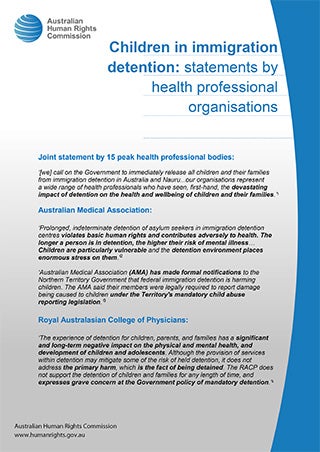
Summary
Joint statement by 15 peak health professional bodies:
‘[we] call on the Government to immediately release all children and their families from immigration detention in Australia and Nauru...our organisations represent
a wide range of health professionals who have seen, first-hand, the devastating impact of detention on the health and wellbeing of children and their families.’[1]
Children in immigration detention: statements by health professional organisations
- PDF download 275.6 KB
- DOCX download 212.5 KB
Joint statement by 15 peak health professional bodies:
‘[we] call on the Government to immediately release all children and their families from immigration detention in Australia and Nauru...our organisations represent a wide range of health professionals who have seen, first-hand, the devastating impact of detention on the health and wellbeing of children and their families.' [1]
Australian Medical Association:
‘Prolonged, indeterminate detention of asylum seekers in immigration detention centres ... Children are particularly vulnerable and the detention environment places enormous stress on them.' violates basic human rights and contributes adversely to health. The longer a person is in detention, the higher their risk of mental illness ... Children are particularly vulnerable and the detention environment places enormous stress on them .' [2]
‘Australian Medical Association to the Northern Territory Government that federal immigration detention is harming children. The AMA said their members were legally required to report damage being caused to children under the Territory's mandatory child abuse reporting legislation.' ‘Australian Medical Association to the Northern Territory Government that federal immigration detention is harming children. The AMA said their members were legally required to report damage being caused to children under the Territory's mandatory child abuse reporting legislation.' .' [3]
Royal Australasian College of Physicians:
Although the provision of services within detention may mitigate some of the risk of held detention, it does not address , which is the fact of being detained. The RACP does not support the detention of children and families for any length of time, and expresses grave concern at the Government policy of mandatory detention.' ‘The experience of detention for children, parents, and families has a significant and long-term negative impact on the physical and mental health, and development of children and adolescents. Although the provision of services within detention may mitigate some of the risk of held detention, it does not address , which is the fact of being detained. The RACP does not support the detention of children and families for any length of time, and expresses grave concern at the Government policy of mandatory detention.' . The RACP does not support the detention of children and families for any length of time, and expresses grave concern at the Government policy of mandatory detention .' [4]
Royal Australian & NZ College of Psychiatrists:
‘detention of children is detrimental to children's development and mental health and has the potential to cause long-term damage to social and emotional functioning ... all child asylum seekers and families with children should be removed immediately from detention and be placed in the community, unless there are special circumstances preventing this that are in the best interests of children.' [5]
Australian College of Nursing (ACN) and Maternal, Child and Family Health Nurses Australia (MCaFHNA):
‘It is the position of ACN and MCaFHNA that . After health and basic security checks have been conducted, ACN and MCaFHNA believe children and their families should be placed in community detention rather than closed immigration detention centres.' ‘It is the position of ACN and MCaFHNA that . After health and basic security checks have been conducted, ACN and MCaFHNA believe children and their families should be placed in community detention rather than closed immigration detention centres.' detention centres.' [6]
Children's Hospital (Westmead Refugee Clinic):
....We working in the HARK Refugee Clinic at the Children's Hospital at Westmead strongly believe that no child should be detained unnecessarily in a detention centre.' ‘A number of children have been deeply traumatised by their time in detention resulting in post-traumatic stress disorder, nightmares and self-harming....We working in the HARK Refugee Clinic at the Children's Hospital at Westmead strongly believe that no child should be detained unnecessarily in a detention centre.'[7] ....We working in the HARK Refugee Clinic at the Children's Hospital at Westmead strongly believe that no child should be detained unnecessarily in a detention centre.'
Royal Children's Hospital (Melbourne):
‘Held detention denies children, adolescents and families the basic environmental requirements for their health, development and wellbeing...There is evidence that all forms of detention adversely affect parenting, family functioning and the mental health of children, adolescents, parents and families...As health professionals we cannot support held detention for children, adolescents or families .' [8]
Forum of Australian Services to Survivors of Torture and Trauma:
The evidence provides a powerful rationale for the requirement specified in the Convention on the Rights of the Child, that children should be detained only as a measure of last resort and for the shortest appropriate period of time.' ‘Evidence from our work with many children over many years indicates that it is certain that detention, particularly when prolonged, may be seriously detrimental to the health and wellbeing of children. The evidence provides a powerful rationale for the requirement specified in the Convention on the Rights of the Child, that children should be detained only as a measure of last resort and for the shortest appropriate period of time.'[9] The evidence provides a powerful rationale for the requirement specified in the Convention on the Rights of the Child, that children should be detained only as a measure of last resort and for the shortest appropriate period of time.'
Australian College of Children and Young People's Nurses:
‘The impacts of detention on children and adolescents' mental health have been well documented... there is a strong association between immigration detention and poor child mental health ...ACCYPN does not support children and young people being kept in detention centres'. [10]
Australian Medical Students' Association:
‘AMSA is opposed to the indefinite mandatory detention and offshore processing of any individual, but particularly children. This is due to the clear causal association between mental illness and immigration detention, which is amplified in children because of their developmental stage. ' [11]
Australian Psychological Society:
[1] ‘Children in detention: a joint statement from Australia's peak health professional bodies', (Media Release, 18 March 2015). At http://www.racgp.org.au/yourracgp/news/news/health-groups-unite-against-children-in-detention/ (viewed 14 May 2015).
[2] Australian Medical Association, Position Statement on Health Care of Asylum Seekers and Refugees – 2011, pp 3-4. At https://ama.com.au/position-statement/health-care-asylum-seekers-and-refugees-2011 (viewed 14 May 2015).
[3] J Bardon, ‘AMA formally notifies NT Government of harm to asylum children at Wickham Point detention facility', ABC News Online, 18 October 2014. At http://www.abc.net.au/news/2014-10-17/ama-informs-nt-govt-about-detention-harm-to-asylum-children/5822322 (viewed 14 May 2015).
[4] Royal Australasian College of Physicians, Submission No 103 to the National Inquiry into Children in Immigration Detention 2014, p 2. Available at http://www.humanrights.gov.auhttps://humanrights.gov.au/our-work/asylum-seekers-and-refugees/submissions-made-inquiry (viewed 14 May 2015)
[5] Royal Australian & NZ College of Psychiatrists, Submission No 48 to the National Inquiry into Children in Immigration Detention 2014, p 2. Available at http://www.humanrights.gov.auhttps://humanrights.gov.au/our-work/asylum-seekers-and-refugees/submissions-made-inquiry (viewed 14 May 2015).
[6] Australian College of Nursing and Maternal, Child and Family Health Nurses Australia, Submission No 136 to the National Inquiry into Children in Immigration Detention 2014, p 2. Available at http://www.humanrights.gov.auhttps://humanrights.gov.au/our-work/asylum-seekers-and-refugees/submissions-made-inquiry (viewed 14 May 2015).
[7] Children's Hospital at Westmead Refugee Clinic, Submission No 1 to the National Inquiry into Children in Immigration Detention 2014, p 1 and 7. Available at http://www.humanrights.gov.auhttps://humanrights.gov.au/our-work/asylum-seekers-and-refugees/submissions-made-inquiry (viewed 19 March 2015).
[8] Royal Children's Hospital Melbourne, Submission No 162 to the National Inquiry into Children in Immigration Detention 2014, p 5. Available at http://www.humanrights.gov.auhttps://humanrights.gov.au/our-work/asylum-seekers-and-refugees/submissions-made-inquiry (viewed 14 May 2015).
[9] Forum of Australian Services for Survivors of Torture and Trauma, Submission No 210 to the National Inquiry into Children in Immigration Detention 2014, pp 16-17. Available at http://www.humanrights.gov.auhttps://humanrights.gov.au/our-work/asylum-seekers-and-refugees/submissions-made-inquiry (viewed 14 May 2015).
[10] Australian College of Children and Young People's Nurses, Submission No 187 to the National Inquiry into Children in Immigration Detention 2014, p 2. Available at http://www.humanrights.gov.auhttps://humanrights.gov.au/our-work/asylum-seekers-and-refugees/submissions-made-inquiry (viewed 14 May 2015).
[11] Australian Medical Students' Association, Submission No 166 to the National Inquiry into Children in Immigration Detention 2014, p 6. Available at http://www.humanrights.gov.auhttps://humanrights.gov.au/our-work/asylum-seekers-and-refugees/submissions-made-inquiry (viewed 14 May 2015).
[12] Australian Psychological Society, Submission No 208 to the National Inquiry into Children in Immigration Detention 2014, p 2. Available at http://www.humanrights.gov.auhttps://humanrights.gov.au/our-work/asylum-seekers-and-refugees/submissions-made-inquiry (viewed 14 May 2015).