
Commission WEBSITE: Healthy Community Projects
Rural Health examples
Desert Acrobats
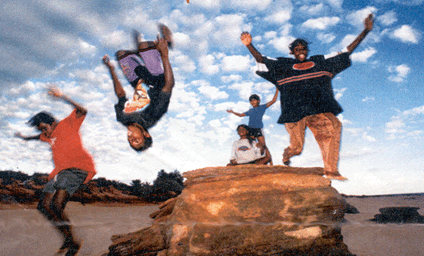
Image:
Saltwater kids meet Desert kids
Young People enjoying what they have learnt from the Desert
Acrobats at Ridell Beach, Broome. Photograph by Michael Hutchinson
On all
the remote communities we visited ... Aboriginal youth excelled in physical
skills and naturally gifted abilities. By setting achievable challenges
the youths were able to feel good about themselves, their abilities, and
their potential. We see this aspect of our activities as crucial in the
building of self-esteem and having very important flow on effects in schooling.
Aims
Desert Acrobats was
set up by the Kimberley Aboriginal Medical Services Council (KAMSC). It
aims to enhance the emotional, social and spiritual wellbeing of individuals
and the communities in which they live. The project promotes and raises
self-esteem and confidence in the young people involved.
What the Program does
The Desert Acrobats
teaching team drives to remote communities of the Kimberley and spends
a week in each community teaching the young people of the community gymnastics,
contemporary Aboriginal dance, theatre, sports and performance.
Schools and communities
visited in 2000
- Beagle Bay
Community School
- Fitzroy Crossing
High School
- Fitzroy's outlying
communities
- Gibb River Community
School
- Mt Barnett Community
School
- Bidyadanga Community
School
What makes it successful
Marie Cox, Coordinator
of the KAMSC Health Promotion Unit, says the positive feedback received
from the communities visited by Desert Acrobats is an indicator of the
success of the Program.
Children that do
not regularly attend school will be present at the time Desert Acrobats
arrives in their community. We observe when we next visit the community
that the children are anxious to show us what they have learnt and done
in our absence.
Difficulties encountered
The Program can only
be delivered in the early dry season. When the wet starts, the roads become
inaccessible.
Marie Cox adds that,
"another difficulty experienced by Desert Acrobats is that two trainees
are required at all times as it is hard to deliver the Program with one
trainee."
Also, funding has
to be applied for each year, as the Program does not receive recurrent
funding. Sita Fitzgerald, a project officer for the project, says this
"makes it very difficult to plan too much in advance, especially if you
have a long term vision and wish to expand."
Funding sources
KAMSC is the main
source of funding for the project.
The project also
receives financial support from:
- Office of Youth
Affairs
- Country Arts
- Gordon Reid
Youth Foundation
- National Rural
Health Alliance.
William Apparel &
Co supplies sports clothing for the project.

